Executive Brief: The 2026 Print Economics Shift
Target Audience: Ownership & Operations Directors
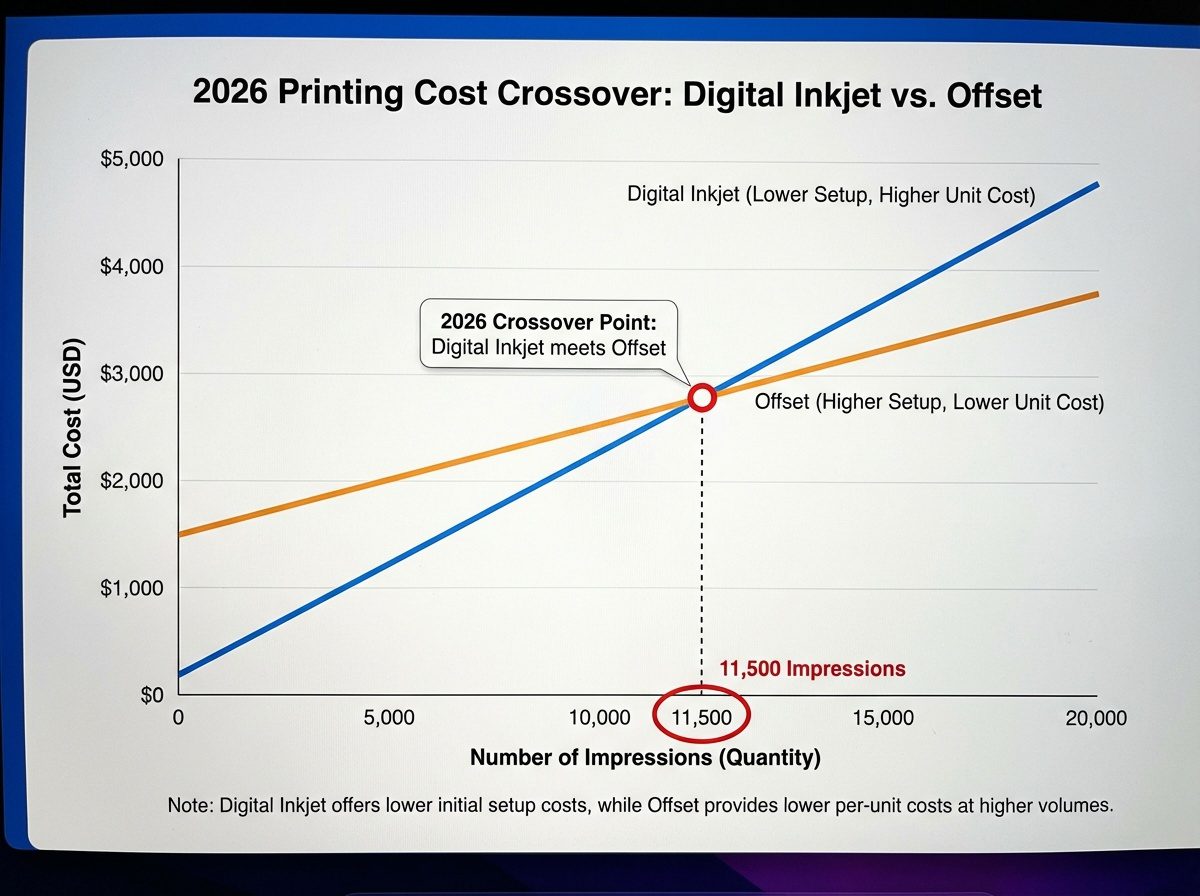
The Bottom Line: As of Q1 2026, the “Crossover Point”—where digital inkjet becomes more cost-effective than offset—has moved from 4,500 to 11500 impressions for standard CMYK work.
This shift is driven by a 22% increase in skilled lithographic labor costs and AI-optimized ink management.
Key Strategic Takeaways:
- The Labor Liability: The “Silver Tsunami” (retiring offset operators) has made human-centric workflows your largest operational risk.
- Energy Efficiency: High-speed inkjet now consumes 30% less energy per 1,000 sheets than traditional dryer-heavy offset lines.
- Market Agility: 65% of Tier-1 print buyers now prioritize “Just-in-Time” delivery over bulk-run price breaks.
Critical Metric: If your average job run-length is under 10000-12000 units, your current offset margin is likely being eroded by makeready waste and labor overhead.

For decades, the math was simple: Offset for volume, Digital for speed.
But in 2026, that equation has been shattered by two variables that no one saw coming: a 45% spike in industrial energy costs and the ‘Silver Tsunami‘—a total vacuum of skilled offset lithographers in the Tier-1 markets.
Today, a print shop’s biggest liability isn’t an aging press; it’s a process that requires a human touch that no longer exists in the labor market.
The average age of a lead offset press operator in the United States is now 58 years old.
In the United Kingdom, 43% of skilled lithographic technicians are projected to retire within the next seven years.
This is not a workforce planning footnote—it is a structural crisis that is fundamentally reordering the cost architecture of commercial print production.
The so-called “Silver Tsunami” has arrived, and for the first time in the industry’s history, the limiting factor in offset profitability is not the price of ink, substrates, or capital equipment.
It is the availability and cost of human expertise.
Simultaneously, the median run length for commercial print work has contracted by 34% since 2019.
Jobs that once justified full makeready and plate imaging now fall into an economic no-man’s-land: too short to amortize offset setup costs, too frequent to ignore.
The result is predictable—profit per job declines while fixed overhead remains constant.
Margin compression becomes systemic.
Many print shop owners respond by discounting to fill capacity, which only accelerates the value destruction.
Others invest in automation—Push-to-Stop systems, inline spectrophotometers, automated plate logistics—but discover that even the most sophisticated offset press cannot eliminate the fundamental economics of fixed setup costs when job sizes continue to decline.
The question is no longer whether digital production inkjet has matured.
It has.
The question is whether your current job mix, labor structure, and capital position make migration economically rational in 2026.
The Data: B1 Offset vs. High-Speed Production Inkjet
Below is the 2026 Technical Benchmark Table.
This data reflects the latest “Peak Performance” offset tech (like the Heidelberg XL 106) versus the newest high-speed production inkjet systems (like the HP Indigo 18K and Canon ProStream).
2026 Technical Comparison: B1 Offset vs. Production Inkjet
| Metric | B1 Peak Offset (e.g., XL 106) | High-Speed Production Inkjet (e.g., HP Indigo 18K and Canon ProStream ) | The Decision Factor |
| Max Rated Speed | 21,000 sheets/hour | 18,000 sheets/hour (Equiv.) | Offset still wins on raw velocity for long runs. |
| Makeready Time | 7.0-12.0 Minutes | 3.0-6.0 Minutes | Inkjet saves ~45 minutes per shift in setup. |
| Setup Paper Waste | 50 – 150 Sheets | 10-15 Sheets | Inkjet is the clear winner for expensive stocks. |
| Consumables Cost | Low (Ink/Plates) | High (Ink/Click/ORC) | Offset ink is ~80% cheaper per liter. |
| Labor Requirement | 2 Highly Skilled Ops | 1 General Tech / AI | Offset operators are harder/more expensive to find. |
| Energy Consum. (kWh) | High (IR/Hot Air Dryers) | Low (LED/High-Eff. Dryers) | Inkjet offers ~30% savings on electricity. |
| Maintenance | Mechanical/Planned | Sensor-based / Predictive AI | Inkjet relies on 2026 “Predictive Intelligence.” |
The traditional offset-to-digital crossover point has destabilized.
The Moving Target: What Influences Your Crossover Point
Seven structural forces are driving a fundamental reassessment of press platform economics in 2026:
Labor Scarcity Premium: Fully burdened offset operator costs now carry a 25–40% premium over digital press operators in major Western markets (USA: $38–$45/hour vs. $28–$34/hour; UK: £20–£26/hour vs. £14–£18/hour).
In Australia, the Fair Work Commission’s recent adjustments combined with a chronic shortage of certified lithographic tradespeople has pushed the hourly burdened rate for offset specialists to AUD $55–$70/hour in metro hubs like Sydney and Melbourne, significantly shortening the digital crossover point compared to regional APAC markets.
As the “Silver Tsunami” accelerates retirements, this gap is widening, making offset’s human capital requirements a material P&L risk rather than a fixed overhead assumption.
Mariusz Sosnowski, CEO of HiFlow Solutions (a major MIS/ERP provider for the packaging and print industry), recently addressed this exact term in a December 2025 executive Q&A:
“The Silver Tsunami is one of the biggest challenges facing packaging and print today.
We’re watching an entire generation of highly skilled operators, estimators, and schedulers retire—people who’ve run these plants for 30 or 40 years and carry enormous tribal knowledge.”
Energy Cost Asymmetry: For print runs of 10,000 impressions, high-speed digital platforms generally consume less total energy than modern sheetfed offset presses.
This is primarily due to the significant energy required for the offset process’s lengthy setup (make-ready) and plate creation.
For long prints run digital presses consume 2–3× more energy per impression.
In regions with industrial electricity rates above $0.14/kWh, this materially impacts unit economics.
In markets where industrial electricity pricing remains volatile or carbon-adjusted, this thermodynamic inefficiency introduces IRR uncertainty that many CFOs have not yet modeled into their capital allocation frameworks.
Sustainable ROI: The Carbon Dividend of Digital Inkjet
In April 2026, the UK Plastic Packaging Tax and the EU Deforestation Regulation (EUDR) have moved from “discussions” to “enforcement.”
Traditional offset printing relies on a chemical-heavy prepress workflow (plates, developers, and fountain solutions).
In contrast, 2026 production inkjet systems have matured into closed-loop, low-VOC (Volatile Organic Compound) environments.
For brands like Apple, Unilever, or Nike, sourcing print is now an ESG (Environmental, Social, and Governance) decision.
By moving volume to inkjet, printers can provide clients with “Carbon-Neutral Certificates”—a service that carries a 10-15% price premium in the current market.
Click-Rate Volatility: Digital platforms operate on click-based service contracts. Effective click rates (including consumables, service, and maintenance) can vary by 18–25% based on contract negotiation and volume commitments.
Waste Tolerance: Offset setup waste of 150+ sheets becomes significant on short runs.
If your shop has low waste recovery or expensive substrate specs, digital’s 10–30 sheet waste profile becomes economically decisive.
The AI-Driven Workflow:The real “Solution” isn’t just the machine; it’s the intelligence behind it.
Modern inkjet systems now utilize Predictive Maintenance.
Instead of a press going down for three days due to a mechanical failure, AI sensors detect wear in real-time, ordering parts before the operator even notices a problem.
“Intelligent automation is not just about improving the printing process, but rethinking everything around it.“
Think of it as the ‘Waze’ of print—AI-driven systems that dynamically adjust to machine downtimes, enable predictive maintenance, and optimize resource allocation in real-time.” — Joan Perez Pericot, Vice President, HP Industrial Print
Furthermore, AI-driven color management (G7+ standards) ensures that a job printed in London looks identical to one printed in New York, regardless of the substrate.
This “Global Consistency” is the #1 requirement for multinational brands in 2026.
Job Mix Fragmentation: If your average job size is declining year-over-year, the crossover point becomes less important than throughput velocity.
Digital’s ability to eliminate makeready and switch jobs in under 5 minutes may have higher strategic value than per-unit cost optimization.
ROI Framework: The Decision Matrix
Use this framework to calculate your shop-specific crossover point:
Step 1: Audit Your Current Job Mix
Analyze the past 12 months:
- What percentage of jobs fall below 5,000 impressions?
- What is your median run length?
- What is your average makeready time per job?
- What is your current setup waste as a percentage of total substrate cost?
Step 2: Calculate True Offset Operating Cost
Your fully burdened offset cost includes:
- Labor (operator + makeready crew)
- Consumables (ink, fountain solution, plates, blankets)
- Energy (press + ancillary equipment + HVAC)
- Maintenance (scheduled service + unplanned downtime)
- Waste (setup sheets + spoilage)
- Overhead allocation (floor space, depreciation)
Critical: Most shops underestimate their true cost per hour by 15–30% because they exclude indirect labor, waste recovery inefficiency, and downtime opportunity cost.
Step 3: Model Digital Alternative Costs
Digital platforms have different cost structures:
- Click charges (typically $0.03–$0.08 per A4 equivalent depending on coverage)
- Consumables (toner, inkjet heads, maintenance kits)
- Energy (higher per-impression but no makeready burn)
- Labor (lower skill requirement, often 1 operator per 2 machines)
- Service contracts (typically 12–18% of capital cost annually)
Step 4: Calculate Your Crossover Point
Formula:

Example:
- Offset fixed cost per job: $180 (makeready labor + plates + setup waste)
- Offset variable cost per impression: $0.022
- Digital fixed cost per job: $15 (File prep. + Digital setup)
- Digital variable cost per impression: $0.048
Crossover = $180-$15 / ($0.048 – $0.022) = 6,346 impressions
Interpretation: Jobs below 6,346 impressions are more profitable on digital. Jobs above this threshold favor offset.
Step 5: Strategic Decision Framework
Your Profile Recommendation
70%+ of jobs below crossover point Strong case for digital migration or hybrid configuration
Balanced mix (40–60% above/below) Hybrid model: retain offset for long runs, add digital for short runs
70%+ of jobs above crossover point Optimize existing offset (automation, labor efficiency) rather than migrate
Declining average run lengths Digital investment becomes defensive—prevents
(>20% reduction in 3 years) Margin erosion as mix continues to shift
The Sustainability Advantage: Beyond Unit Economics
High-speed inkjet eliminates several environmental and operational burdens that offset lithography cannot avoid:
Chemistry Elimination:
- No CTP plate processing (developer, fixer, gum)
- No fountain solution (isopropyl alcohol, VOCs)
- No blanket wash solvents
- Reduction of hazardous waste streams by 85–90%
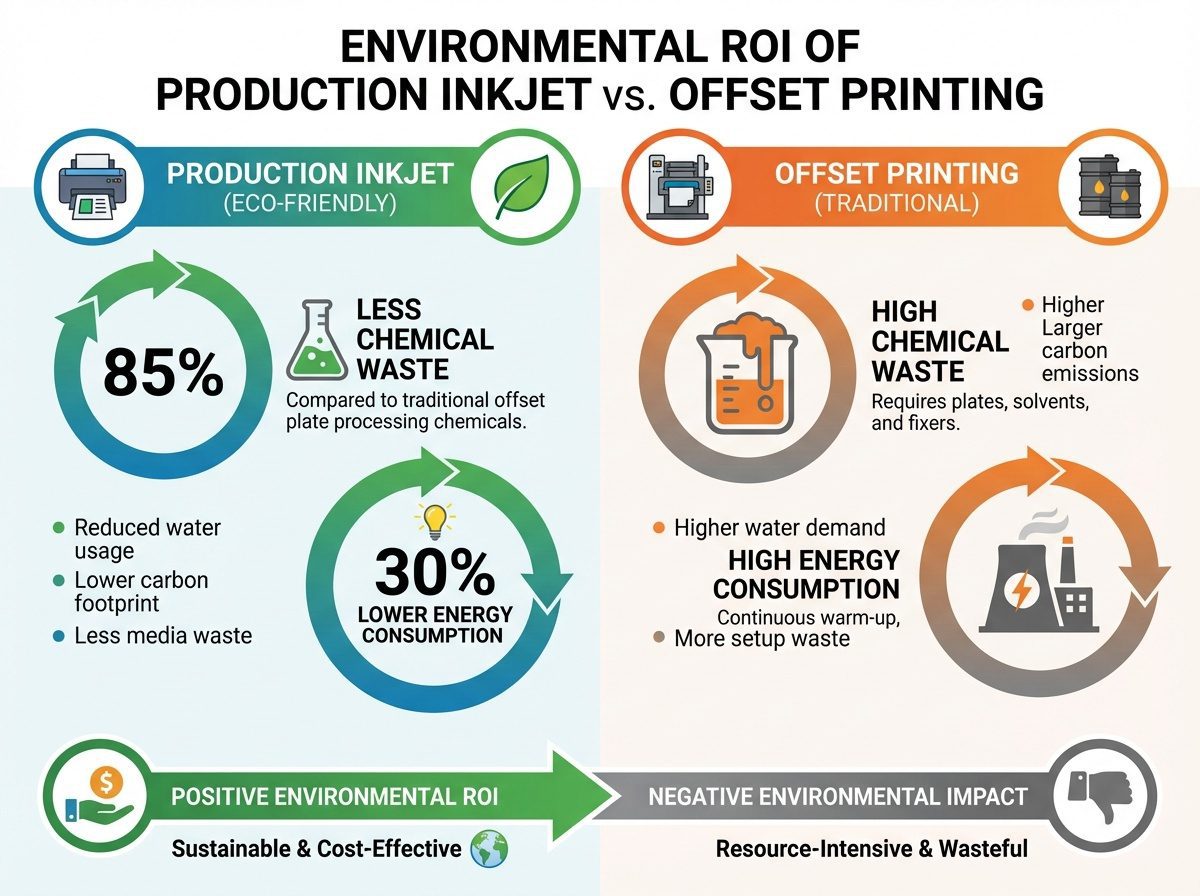
Regulatory Compliance: Many jurisdictions (California, EU member states) are tightening VOC emission standards for commercial print facilities.
Offset operations using traditional fountain solutions may face compliance costs or operational restrictions that do not apply to waterless digital systems.
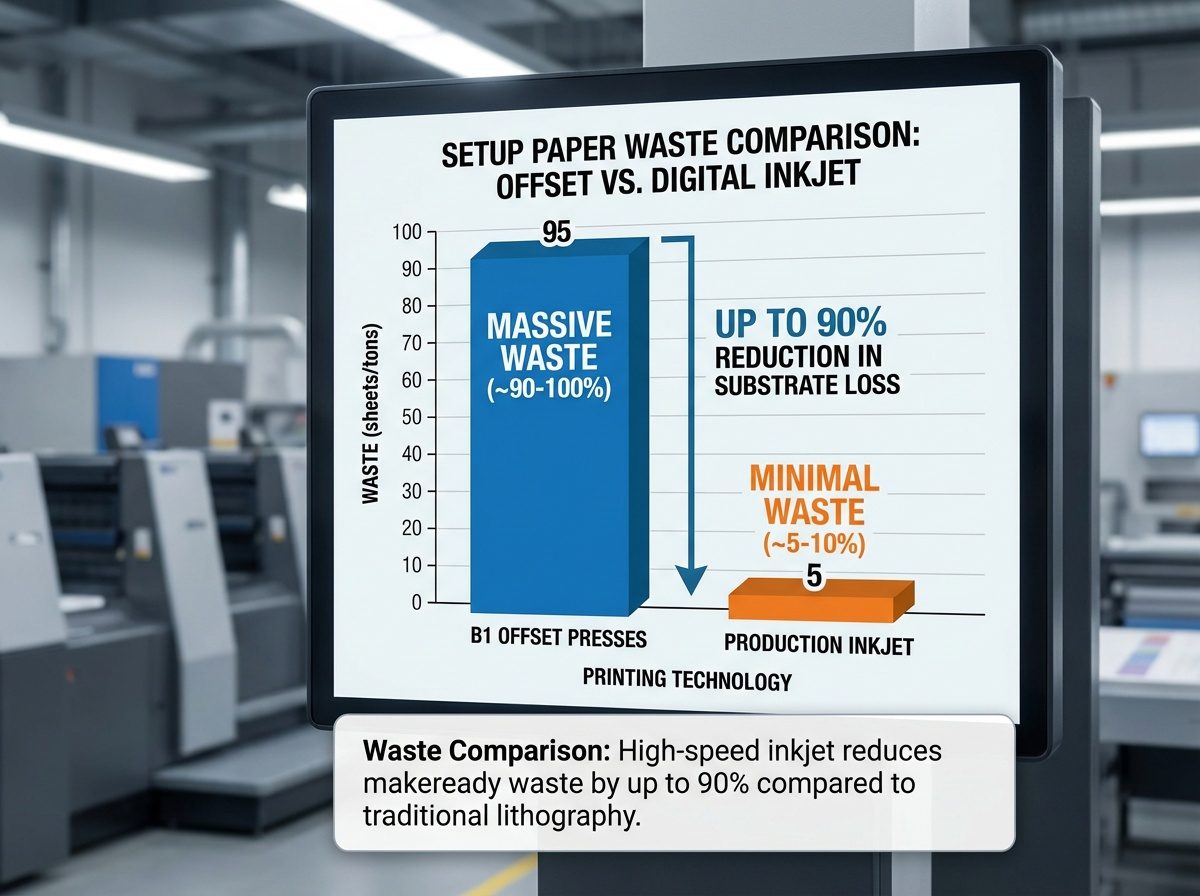
Waste Reduction: Setup waste reduction from 200-300 sheets to under 30 sheets per job represents a 90% material efficiency gain.
What is “setup waste”? When an offset press operator starts a new job, they need to achieve proper ink-water balance, register alignment, and color density before production-quality sheets come off the press.
The sheets printed during this calibration phase are called “makeready waste” or “setup waste.”
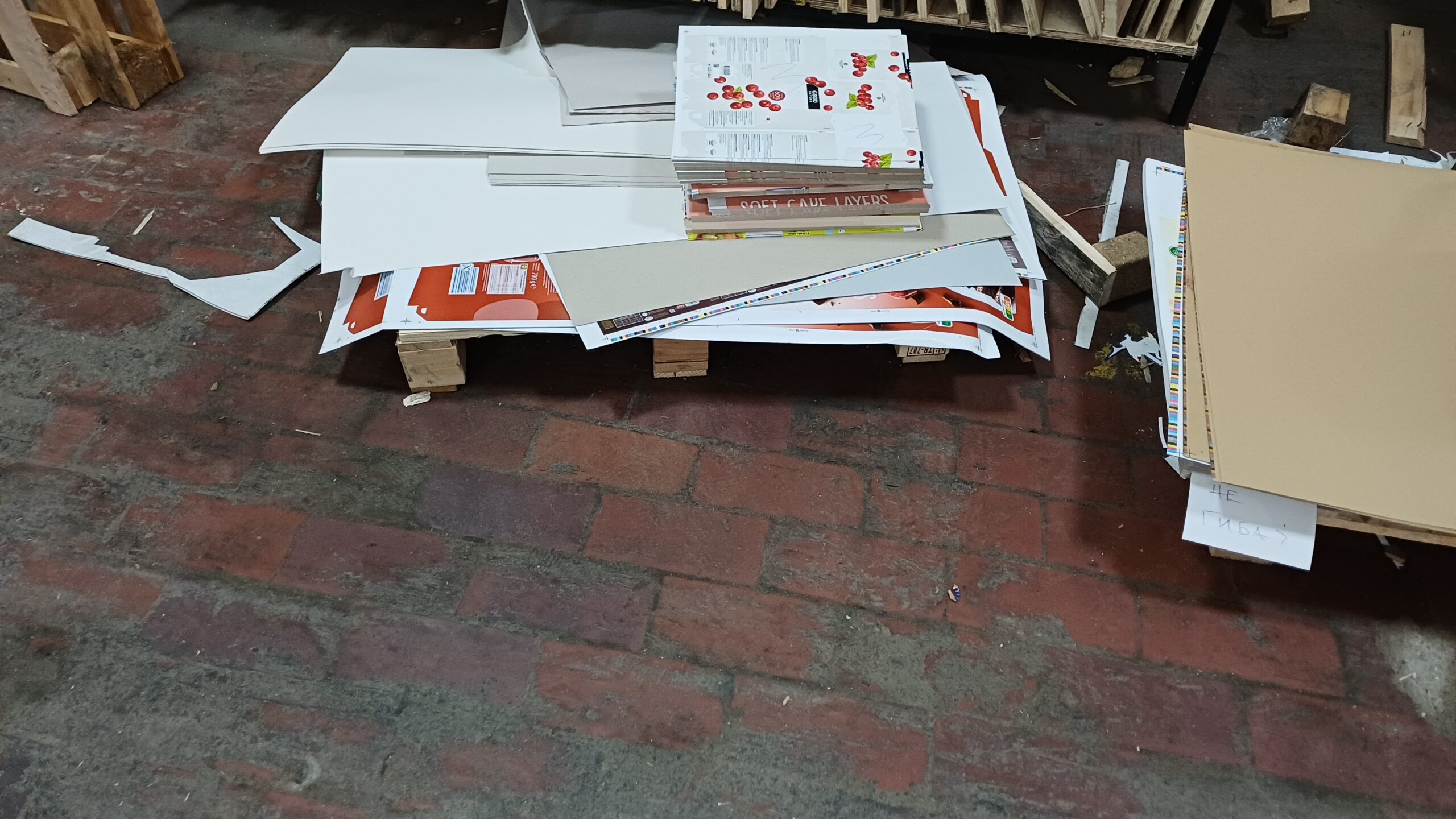
Offset Reality:
- A modern B1 offset press (like the Heidelberg XL 106) typically requires 250-350 sheets to reach stable production quality
- This happens on every single job
- These sheets cannot be sold—they go straight to waste/recycling
- You still pay for the substrate, ink, and press time
Digital Reality:
- High-speed inkjet (HP Indigo, Canon ProStream) requires 10-30 sheets for setup
- Why so few? No ink-water balance to achieve, no plate registration, no mechanical color-to-color alignment
- Imaging is digital—first sheet quality is nearly identical to sheet 10,000
The Annual Math
Let’s use a mid-sized commercial print shop as an example:
Assumptions:
- 200 jobs per month = 2,400 jobs annually
- Conservative offset waste: 300 sheets per job average
- Conservative digital waste: 25 sheets per job average
Annual Waste Calculation:
Offset: 2,400 jobs × 300 sheets = 720,000 waste sheets/year
Digital: 2,400 jobs × 25 sheets = 60,000 waste sheets/year
Net Reduction: 720,000 – 60,000 = 660,000 fewer waste sheets
For shops running 200+ jobs monthly, this translates to 600,000–660,000 fewer waste sheets annually—a material reduction in landfill burden and substrate procurement cost.
The Real Cost Impact
Material Cost: Let’s say you’re running standard 170gsm coated stock at $0.08/sheet (bulk pricing):
- 660,000 sheets × $0.08 = $52,800 in substrate savings annually
But wait—there’s more hidden cost:
- Ink Cost: Those waste sheets still consumed ink (CMYK + any spot colors)
- Estimated additional cost: $8,000-$12,000/year
- Disposal/Recycling Cost: You pay to haul away waste
- Estimated cost: $2,000-$4,000/year
- Press Time: Makeready burns billable press hours
- 2,400 jobs × 10 minutes average = 400 hours of non-productive press time
- At $150/hour effective press rate = $60,000 opportunity cost
Total Hidden Annual Cost of Offset Setup Waste: $52,800 (substrate) + $10,000 (ink) + $3,000 (disposal) + $60,000 (opportunity cost) = ~$125,800/year
Why This Matters Strategically
For CFOs: This isn’t “waste”—it’s a recurring operational tax that compounds with every job.
It’s particularly painful on short-run work where the waste represents a higher percentage of total job cost.
Example:
- 2,000-sheet job on offset = 300 waste sheets = 15% material loss before you sell a single sheet
- Same job on digital = 25 waste sheets = 1.25% material loss
For Sustainability Officers: 660,000 sheets = approximately:
- 13.2 tons of paper waste annually (at 170gsm)
- Equivalent to ~225 trees (rough forestry math)
- Landfill/recycling logistics for 40-50 full pallets of waste
This is measurable environmental impact reduction that can be reported in ESG disclosures or sustainability certifications.

The waste reduction claim isn’t marketing spin—it’s mechanical reality.
Offset lithography requires physical calibration on every job. Digital inkjet does not.
For shops running high job counts (150+ jobs/month) with declining average run lengths, setup waste becomes a structural profitability drain that no amount of operator skill can eliminate.
This is why the “crossover point” has shifted: When waste represents 10-20% of total job material cost on short runs, digital’s 90% waste reduction can offset its higher per-impression click cost.
Energy Considerations: While digital presses consume more energy per impression, they eliminate makeready energy burn and reduce HVAC load from solvent evaporation.
The net energy position depends on the job mix: short-run, heavy shops may see comparable or lower total energy consumption with digital, despite higher per-impression usage.
The Hybrid Model: The Pragmatic Middle Ground
Most established commercial printers should not view this as a binary choice.
The optimal configuration for 2026 is often a hybrid model:
- Retain offset capacity for runs above 8,000–12,000 impressions where unit economics remain decisively favorable
- Add high-speed digital for sub-5,000 runs where makeready and waste erode offset profitability
- Implement intelligent job routing via MIS integration to automatically assign work to the economically optimal platform
This approach:
- Preserves existing capital investment and skilled labor
- Captures margin improvement on short-run work
- Provides operational flexibility as job mix continues to evolve
- Reduces risk compared to wholesale technology replacement
Call to Action: Audit Your Exposure
The crossover point is not a hypothetical exercise.
It is a diagnostic tool that reveals whether your current equipment configuration is optimized for your actual 2026 workload—or whether you are systematically leaving margin on the table.
Conduct a 90-day audit:
- Job Mix Analysis: Calculate what percentage of your jobs fall below your shop-specific crossover point
- True Cost Modeling: Determine your fully burdened offset cost including waste, indirect labor, and opportunity cost of long makeready cycles
- Capacity Utilization: Measure your offset OEE—many shops discover they are running at 45–60% effective utilization due to job fragmentation
- Labor Risk Assessment: Identify how many of your offset operators are within 5 years of retirement and what replacement cost or wage premium you will face
If this audit reveals that more than 50% of your current jobs fall below your crossover point, you have a structural profitability issue that discounting or operational tweaking will not solve.
You need a technology strategy.
The 2026 Crossover Point Matrix (The CEO’s Guide)
| Job Type | Run Length: < 5,000 | Run Length: 5k – 12k | Run Length: 15,000+ |
| Simple CMYK (Flyers) | INKJET (Higher margin) | CROSSOVER ZONE | OFFSET (Lowest unit cost) |
| Premium Stocks / Coatings | INKJET (Less waste) | INKJET | OFFSET |
| Variable Data / Versioning | INKJET (Required) | INKJET | INKJET |
| Spot Color (Pantone) | OFFSET | OFFSET | OFFSET |
In 2024, the “Crossover Point” for A4 brochures was roughly 7,000 units.
In 2026, due to massive reductions in inkjet ink pricing and the rising cost of aluminum for offset plates, that point has shifted to 11,500 – 12,000 units.
The 2026 printing landscape rewards precision—not tradition.
The question is not whether offset or digital is “better.”
The question is which configuration maximizes margin across your specific job mix, labor structure, and market position.
The answer requires data, not instinct.
About This Analysis: This white paper is based on 2026 industry benchmarking data from production environments in North America, UK, and Australia.
Specific cost figures should be adjusted for regional labor rates, energy pricing, and equipment configuration.
For shop-specific ROI modeling, consult with equipment manufacturers or independent production consultants who can access your actual job costing data.