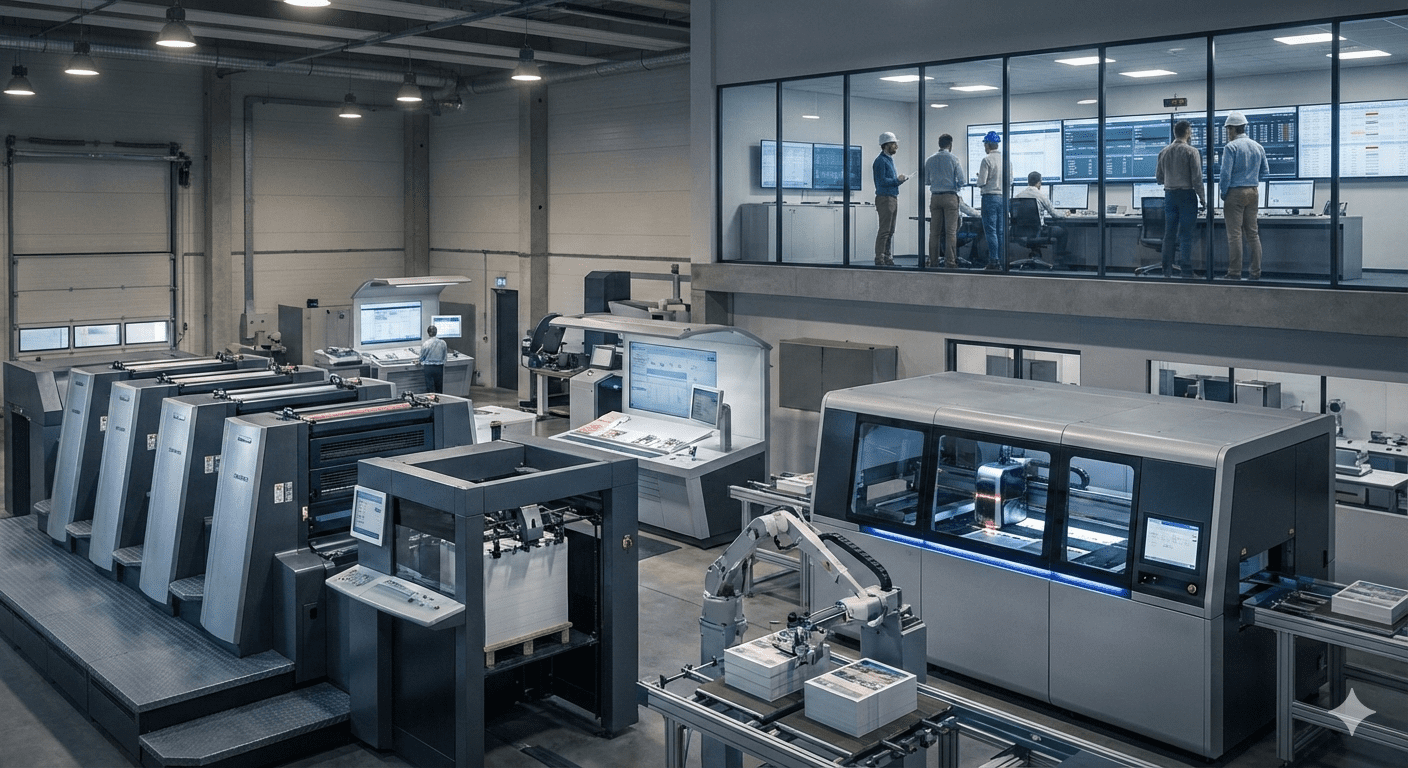
Executive Snapshot: The 2026 Print Outlook
The Bottom Line: The global print market is undergoing a “Great Realignment.” Success through 2030 is no longer about volume; it is about integration, intelligence, and impact.
Market Velocity: The global sector will hit $598.06B by 2030, but the real story is Digital. Digital print is on a trajectory to reach $251.1B by 2035, fundamentally displacing traditional offset economics for short-run, high-value jobs.
The AI Backbone: AI has moved from “hype” to “infrastructure.” The most profitable operators are now using Predictive Maintenance and Automated Color Management to protect margins against rising substrate and labor costs.
Sustainability as a Mandate: Energy-efficient UV LED curing and waterless offset are no longer “green options”—they are procurement requirements. Jurisdictions are increasingly mandating zero-waste and full materials traceability.
New Revenue Moats: High-margin growth is concentrated in Printed Electronics (IoT), Smart Packaging (NFC/QR), and Additive Manufacturing (3D) for healthcare and aerospace.
Operational Risk: As print goes “cloud-native,” Cybersecurity is now a Tier-1 manufacturing risk. Protecting design files and customer data is as critical as maintaining the presses.
The global commercial print market, valued at $501.36 billion in 2024, is projected to reach $598.06 billion by 2030.
That headline figure masks a far more consequential shift: the growth is not proportional across technologies.
Digital printing — currently a fraction of total volume — is forecast to reach $48.4 billion by 2030 and potentially $251.1 billion by 2035.
The compounding growth rate of digital relative to offset is the signal executives must not ignore.
Three forces are converging simultaneously: the maturation of digital and additive manufacturing technologies, an intensifying regulatory and consumer-driven sustainability mandate, and the proliferation of AI-driven automation across prepress, production, and post-press workflows.
These are not sequential trends. They are co-occurring, and they interact.
Regional dynamics add further complexity.
Asia-Pacific is leading growth velocity; North America retains dominant market share.
European operators face the most acute sustainability compliance pressures.
No single playbook applies universally — but certain principles hold across every market.
| Metric | 2024 Value | 2030 Projection | CAGR (est.) |
| Commercial Print Market | $501.36B | $598.06B | ~3.0% |
| Digital Print Market | ~$28B | $48.4B | ~9.5% |
| Digital Print (Extended) | — | $251.1B (2035) | ~15%+ |
| Asia-Pacific Growth Rate | Highest globally | Accelerating | Leading |
| North America Market Share | Dominant | Sustained | Stable |
The Digital Transition: Structural Shift, Not Cyclical Trend
The displacement of offset by digital printing has been underway for two decades.
What has changed is the pace and the economics.
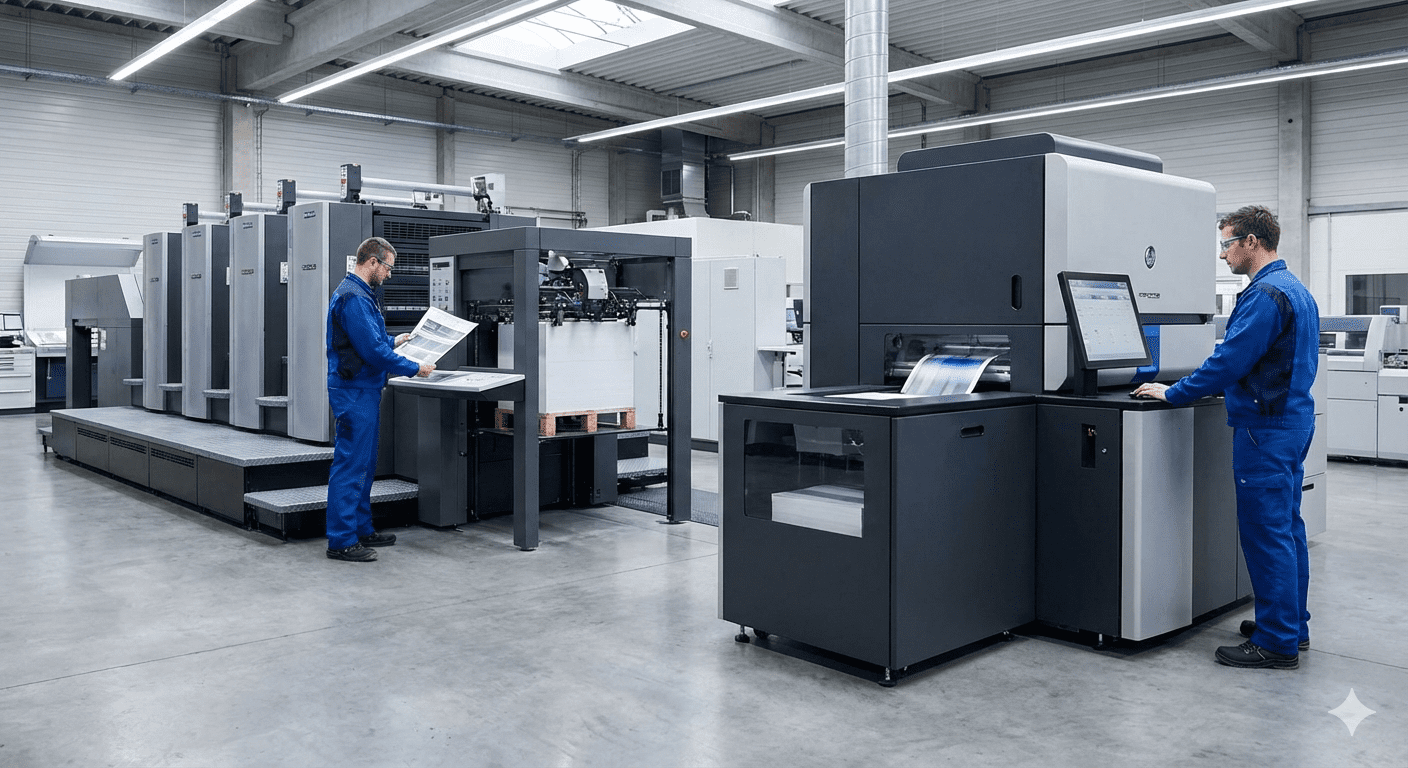
Advanced inkjet and electrophotographic (laser) systems now match or exceed offset quality thresholds in an expanding range of applications, while delivering operational advantages that compound over time.
Speed-to-Market and Operational Agility
Offset printing’s value proposition has historically rested on cost-per-unit efficiency at scale.
That advantage narrows materially below certain run lengths — and the market is structurally shifting toward shorter, more frequent runs.
E-commerce penetration, SKU proliferation, and inventory compression strategies across retail, pharma, and FMCG sectors are all accelerating this dynamic.
Digital printing eliminates plate origination, dramatically compresses make-ready time, and enables same-day or next-day turnaround on jobs that once required multi-day scheduling windows.
For operators serving sectors with time-sensitive demand — fashion, direct mail, event marketing, regulatory labelling — this is a structural competitive advantage, not a marginal improvement.
Variable Data Printing: The Revenue Multiplier
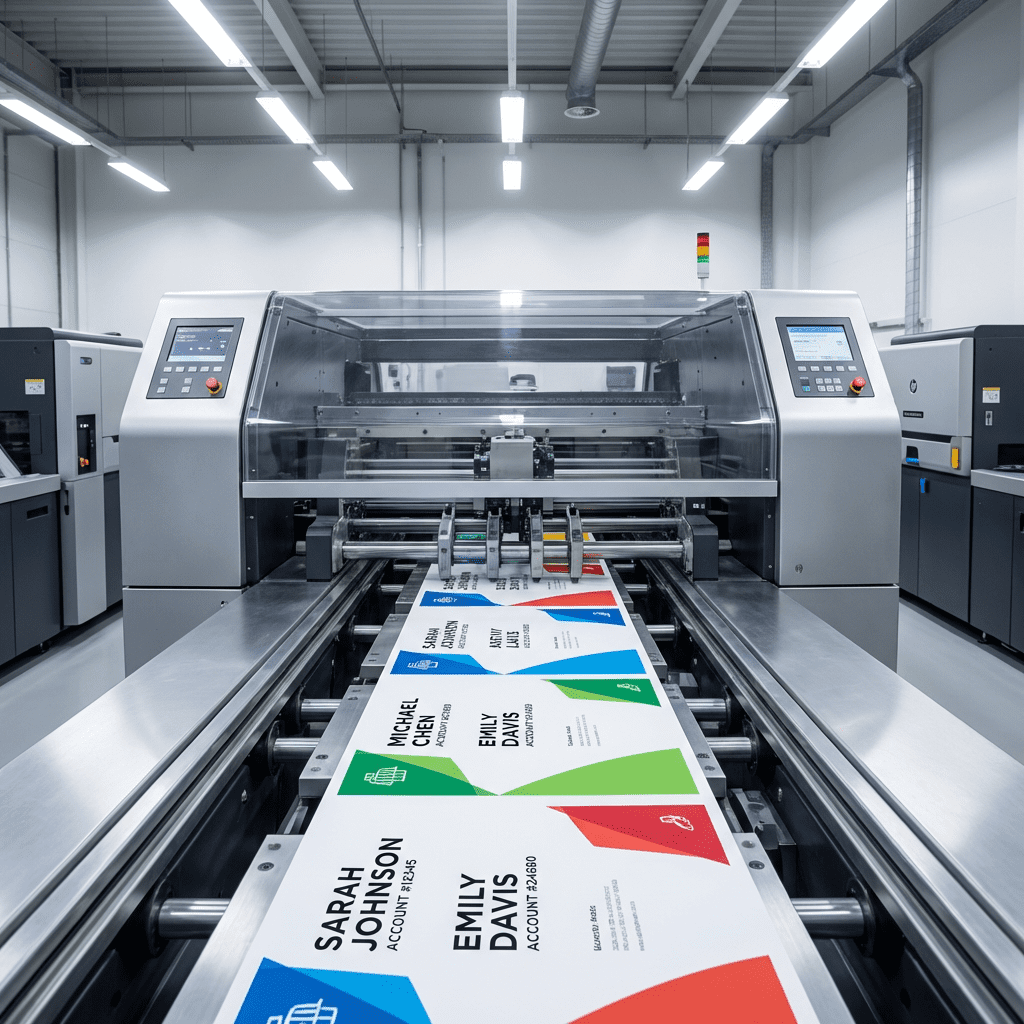
Variable data printing (VDP) remains the most underutilised capability in the mid-market operator’s toolkit.
The ability to individualise content at the unit level — personalised name, offer, imagery, language — on high-volume runs has been validated repeatedly in direct mail and pharmaceutical patient communications.
Engagement rates and conversion lifts are not incremental; they are categorical.
The strategic opportunity extends beyond marketing.
Regulatory compliance in pharmaceuticals, food, and financial services increasingly mandates unit-level traceability.
VDP-capable operators are positioned to capture this compliance-driven demand as labelling regulations tighten across major markets.
Hybrid Integration: Pragmatic, Not Compromise
The narrative of digital replacing offset misframes the near-term operational reality for most large-format commercial printers.
Hybrid press configurations — combining offset’s high-speed throughput with inline digital personalisation or selective coating — represent the most capital-efficient path for established operators managing mixed job portfolios.
Workflow integration, however, remains the hidden variable.
Digital tools in prepress, proofing, and finishing that cannot communicate with legacy MIS and ERP systems generate friction that erodes the speed advantages of the physical technology.
Technology acquisition without workflow architecture investment is a common and costly error.
Additive Manufacturing: Industrial Maturity Beyond Prototyping

3D printing has crossed a critical threshold: it is no longer principally a prototyping technology.
Across aerospace, medical devices, construction, and defence, additive manufacturing is producing functional end-use components at commercial scale.
The implications for both suppliers and downstream industries that interact with the print sector are material.
Core Process Technologies and Their Commercial Domains
| Process | Key Capability | Primary Sectors | Maturity Level |
| Fused Deposition Modelling (FDM) | Low-cost thermoplastic parts | Consumer, Education, Tooling | Mature / Commoditised |
| Stereolithography (SLA) | High-resolution resin parts | Medical, Dental, Jewellery | Mature / High-Value |
| Selective Laser Sintering (SLS) | Complex functional polymers | Aerospace, Automotive, Orthotics | Advanced / Growing |
| Direct Metal Laser Sintering (DMLS) | End-use metal components | Aerospace, Defence, Implants | Advanced / High-Capex |
| Direct Ink Writing (DIW) | Multi-material deposition | Soft Robotics, Biomedical | Emerging / High Potential |
Healthcare: The Highest-Stakes Application
The convergence of SLA, SLS, and emerging bioprinting with patient-specific medical data is producing a new category of custom prosthetics, orthopaedic implants, and — in research settings — bioprinted tissue scaffolds.
The precision requirements and liability exposure in this domain are substantial.
Quality management systems, materials traceability, and regulatory compliance frameworks are not optional components; they are operational prerequisites for any operator targeting this market.
Construction-Scale Additive Manufacturing
Large-format 3D printing of structural concrete and composite materials is transitioning from pilot projects to contracted residential and infrastructure applications in multiple markets, including the US, Netherlands, UAE, and China.
Lead times, labour cost profiles, and material waste metrics in construction 3D printing are compelling relative to conventional methods for certain structure typologies.
The constraints remain materials standardisation, building code integration, and financing structures that recognise the technology’s risk profile.
Specialised Technologies: Where Next-Generation Margins Are Being Built

Printed Electronics: The Convergence of Print and Electronics Manufacturing
Printed electronics — direct deposition of conductive, semiconductive, and dielectric materials onto flexible or rigid substrates — represents one of the most commercially significant adjacent markets for advanced print operators.
The technology base is established: screen printing and inkjet deposition of silver, copper, and carbon inks are in commercial production across multiple application categories.
The addressable market spans IoT sensor arrays, flexible photovoltaic panels, automotive HMI surfaces, anti-counterfeiting features in high-security packaging, and wearable health monitoring devices.
Operators who can demonstrate substrate compatibility, dimensional registration precision, and conductive ink qualification processes are positioned in a market segment with substantially higher margins than commodity commercial print.
Micro- and Nano-Scale Fabrication
Electrohydrodynamic (EHD) printing and laser-induced forward transfer (LIFT) operate at feature scales below the resolution threshold of conventional digital printing systems.
Current applications include flexible micro-displays, biochips for point-of-care diagnostics, micro-optical arrays, and targeted drug delivery microstructures.
These are primarily the domain of specialist manufacturers and research institutions today, but the commercial diffusion trajectory follows the same pattern as inkjet did two decades ago.
Strategic awareness is warranted now.
Automation and AI: Infrastructure, Not Innovation Theatre

The print industry’s adoption of artificial intelligence and automation warrants clear-eyed assessment.
The commercial value is real and demonstrable in specific operational contexts.
The risk is investing in AI-branded solutions that generate marginal efficiency gains while distracting from foundational workflow and data infrastructure deficiencies.
Where AI Delivers Verified Operational Value
| Predictive Maintenance: Predictive maintenance modelling on high-capex press equipment — reducing unplanned downtime, which remains one of the highest-margin destroyers in large-format production environments. Colour & Quality Control: Colour management and spectrophotometric correction in closed-loop press control systems — reducing waste sheets and substrate cost on long runs. Layout Optimisation: AI-assisted layout and imposition optimisation — reducing prepress labour time on complex jobs with multiple SKUs or page variants. Personalisation Engines: Customer data-driven content personalisation in direct mail and transactional print workflows — measurably improving response rates when implemented with clean data inputs. |
The Human Imperative in AI Integration
AI tools in print production are instruments in the hands of experienced operators, estimators, and production managers — not substitutes for them.
The judgment calls that determine profitability in a commercial print operation — how to sequence a mixed job queue under a substrate shortage, how to reprice a job when a key press goes down, how to retain a client whose spec has changed mid-production — require contextual understanding and relationship intelligence that no current AI system possesses.
Leadership teams that allow AI adoption narratives to obscure investment in operator skills, supervisory development, and experienced technical management will find themselves with technically sophisticated but organisationally fragile operations.
The most capable print operations in 2030 will be those where skilled humans and AI tools are integrated purposefully — not those where one is positioned as a replacement for the other.
Sustainability: From Compliance Obligation to Commercial Differentiator
Sustainability in print is no longer a CSR footnote. It is becoming a procurement criterion, a brand equity driver, and — in an increasing number of jurisdictions — a regulatory compliance requirement.
The operators who treat sustainability investments as cost centres rather than positioning assets are misreading the competitive landscape.

Materials: The Foundation of the Sustainability Case
Recycled and FSC-certified paper stocks, vegetable- and soy-based ink systems, and biodegradable laminate alternatives are now commercially available across the majority of print applications.
The cost premium over conventional materials has narrowed materially in the past five years and continues to compress as supply chains scale.
The barrier for most operators is not availability; it is procurement infrastructure and supplier qualification.
Process Innovations with Immediate ROI
Waterless offset printing eliminates the isopropyl alcohol-based dampening systems that represent one of the largest VOC emission sources in conventional lithographic operations — while also improving dot gain consistency and reducing substrate waste from hickeys and wash-up cycles.
The capital cost of conversion is significant, but the operational savings in chemistry,waste disposal, and substrate waste compound favourably over a standard asset depreciation horizon.
UV LED curing systems, replacing conventional UV lamp curing in digital and hybrid press applications, deliver energy consumption reductions of 50–80% relative to mercury arc systems while eliminating ozone generation and reducing heat transfer to temperature-sensitive substrates.
In high-volume digital production environments, the energy saving is financially material within 12–18 months of installation.
Print-on-demand and web-to-print workflow architectures reduce overrun waste systemically — addressing one of the highest-volume waste streams in commercial print.
For publishers, retailers, and catalogue printers, the inventory carrying cost elimination often exceeds the per-unit cost premium of on-demand production at moderate run lengths.
Ethical, Legal, and Security Risk: The Governance Gap
The industry’s accelerating capability development is outpacing the governance frameworks required to manage it responsibly.
Three risk domains warrant immediate executive attention.

3D Bioprinting: Equity, Regulation, and Liability
Custom bioprinted prosthetics and implants currently serve patients in markets with advanced healthcare infrastructure and the financial means to access them.
The technology’s potential to address global unmet medical need is substantial — and currently unrealised at scale, primarily due to cost and regulatory fragmentation.
As regulatory frameworks for bioprinted devices mature across the FDA, EMA, and equivalent bodies, operators entering this space will need robust quality management, clinical validation partnerships, and liability structures that conventional print insurance frameworks do not accommodate.
Intellectual Property: Replication at Scale
Additive manufacturing fundamentally alters the cost economics of IP infringement.
A design file transmitted across a network and printed locally has near-zero marginal reproduction cost.
Patent-protected components, trademarked product shapes, and copyrighted industrial designs are all exposed.
The legal frameworks governing digital design file distribution, liability for infringing prints, and enforcement across decentralised production networks are nascent and inconsistent across jurisdictions.
Operators in contract manufacturing 3D printing must implement design file provenance verification, licensing compliance tracking, and client indemnification clauses as standard commercial practice — not as optional risk management additions.
Cybersecurity: The Print Network Attack Surface
Modern print production infrastructure — networked presses, cloud-based MIS, remote monitoring systems, design file repositories, and customer data platforms — constitutes a significant and often underestimated attack surface.
Design file tampering mid-workflow can introduce dimensional errors in functional parts, with safety-critical consequences in aerospace and medical applications.
Customer personalisation data represents a high-value target under GDPR, CCPA, and sector-specific data protection regimes.
| MINIMUM CYBERSECURITY REQUIREMENTS FOR CONNECTED PRINT OPERATIONS File Security: End-to-end encryption for design file transmission and storage Access Control: Multi-factor authentication across all production network access points Vulnerability Management: Regular penetration testing of MIS and press control network infrastructure Incident Response: Documented incident response protocols specific to production environment breach scenarios Data Governance: Data minimisation and retention policies aligned to applicable privacy regulations |
Strategic Priorities: Decisions That Cannot Be Deferred
The following priorities are not exhaustive — they are the decisions with the highest consequence for competitive positioning through 2030. Delay compounds disadvantage.
| Priority | Action Required | Time Horizon | Risk of Inaction |
| Digital Transition Architecture | Audit current offset:digital job mix. Model the economics of hybrid or full digital conversion at current vs. projected run-length distribution. | 0–18 months | Volume loss to digitally-native competitors |
| Sustainability Credentials | Establish certified sustainable materials procurement and waterless/LED process roadmap. Obtain third-party verification. | 12–24 months | Loss of brand-conscious and regulated-sector clients |
| AI & Automation Investment | Prioritise predictive maintenance and colour management AI. Build data infrastructure before deploying AI tools. | 6–24 months | Margin erosion from downtime and waste |
| Cybersecurity Posture | Commission independent security assessment of production network. Implement encryption and access controls. | 0–6 months | Regulatory liability, operational disruption, reputational damage |
| Workforce Development | Invest in operator retraining for digital and hybrid press environments. Retain experienced technical supervisors. | Ongoing | Skill gaps that technology cannot compensate for |
Conclusion: The Operators Who Will Define the Next Decade
The print industry in 2030 will be defined by the decisions made between now and 2026.
Capital allocation, technology roadmaps, workforce development, and governance frameworks established in this window will compound — favourably or unfavourably — across the remainder of the decade.
The operators who will lead are not necessarily those with the largest existing infrastructure or the longest client relationships.
They are those who can read the convergence of digital, additive, and sustainable manufacturing as an integrated strategic challenge — and respond with the organisational discipline and capital commitment that convergence demands.
Print is not a declining industry. It is an industry in selective contraction and selective expansion, simultaneously.
The contraction is in undifferentiated, high-volume, low-margin commodity print.
The expansion is in personalised, on-demand, sustainable, electronically-integrated, and functionally-complex print — areas that command higher margins, deeper client relationships, and stronger competitive moats.
| The fundamental question for every print operator is not whether the industry is changing — it manifestly is — but whether your organisation is moving fast enough, in the right direction, with sufficient clarity of purpose to be among the operators who define the next chapter rather than those displaced by it. |
This report is produced for strategic advisory purposes. Market projections are sourced from publicly available industry research and are subject to revision. All strategic recommendations should be validated against operator-specific financial, operational, and market data prior to implementation