30-second version for the CEO: Your skilled printing press operators are leaving.
There are no new workers who will come to learn and stay.
Similarly, the colour management method that keeps your margins together—based on, let say, 15,000 hours of experience as an offset printer—goes with them.
In 2026, shops that use the “Eyeball Method” lose an average of 12% of their margin because it takes longer for the printer to prepare the machine for the working order (25–35 minutes), which is normal for this method, and there is a lot of substrate waste (8–12%).
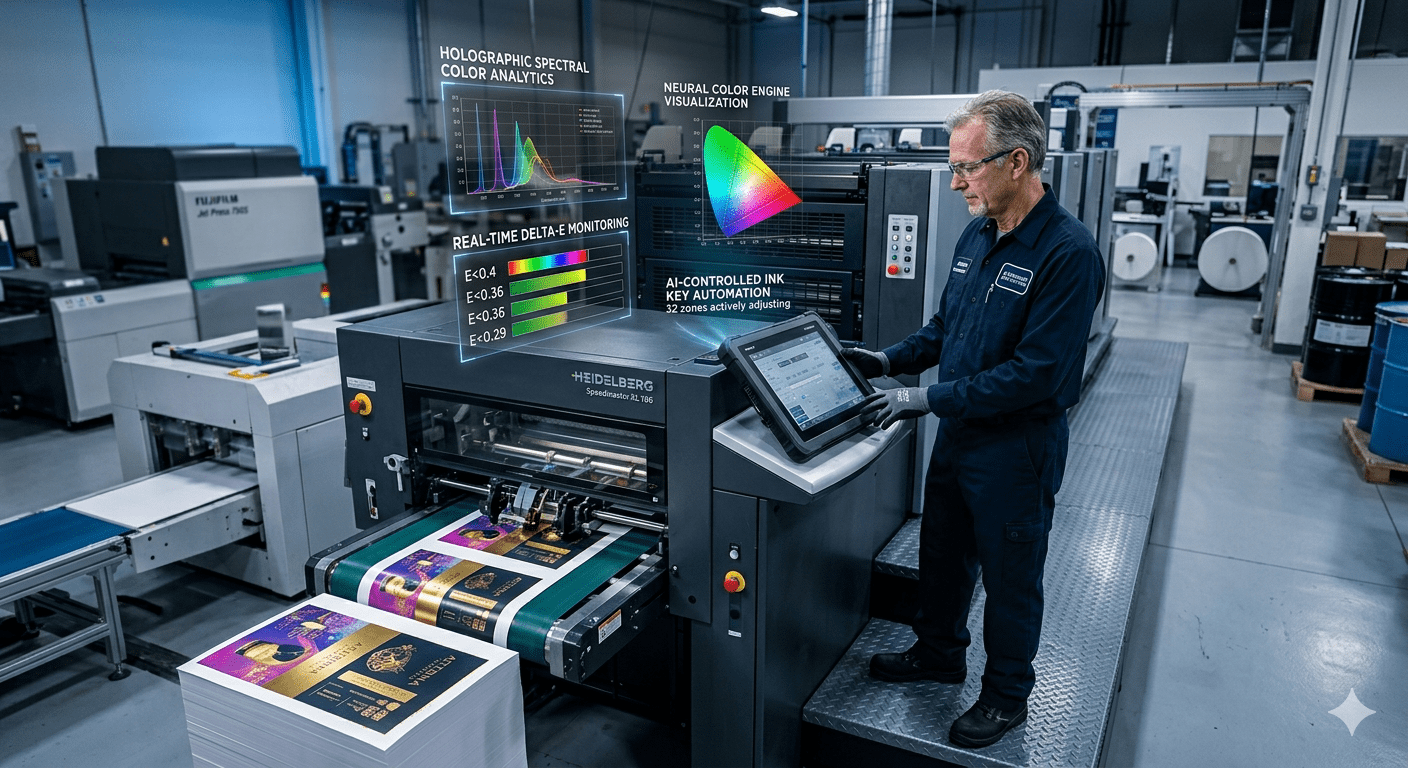
Agentic AI Colour Management, on the other hand, uses neural colour engines with G7 Master Calibration frameworks and predictive ink-key control to get ΔE<1.0 across a wide range of substrates.
Also, the time for preparing the machine for the job drops to less than 7 minutes, and the amount of substrate waste drops to less than 1.5%.
One more very important thing: your junior print operators will no longer be ink guessers, they will be ink orchestrators.
This isn’t just a talk about technology. This is a talk about how to make money.
The question isn’t whether you can afford to use AI Colour Management,it’s whether you can afford the 12% margin bleed that comes from not using it.
THE DEATH OF SUBJECTIVITY
Human Vision as a Structural Liability in Managing Colors
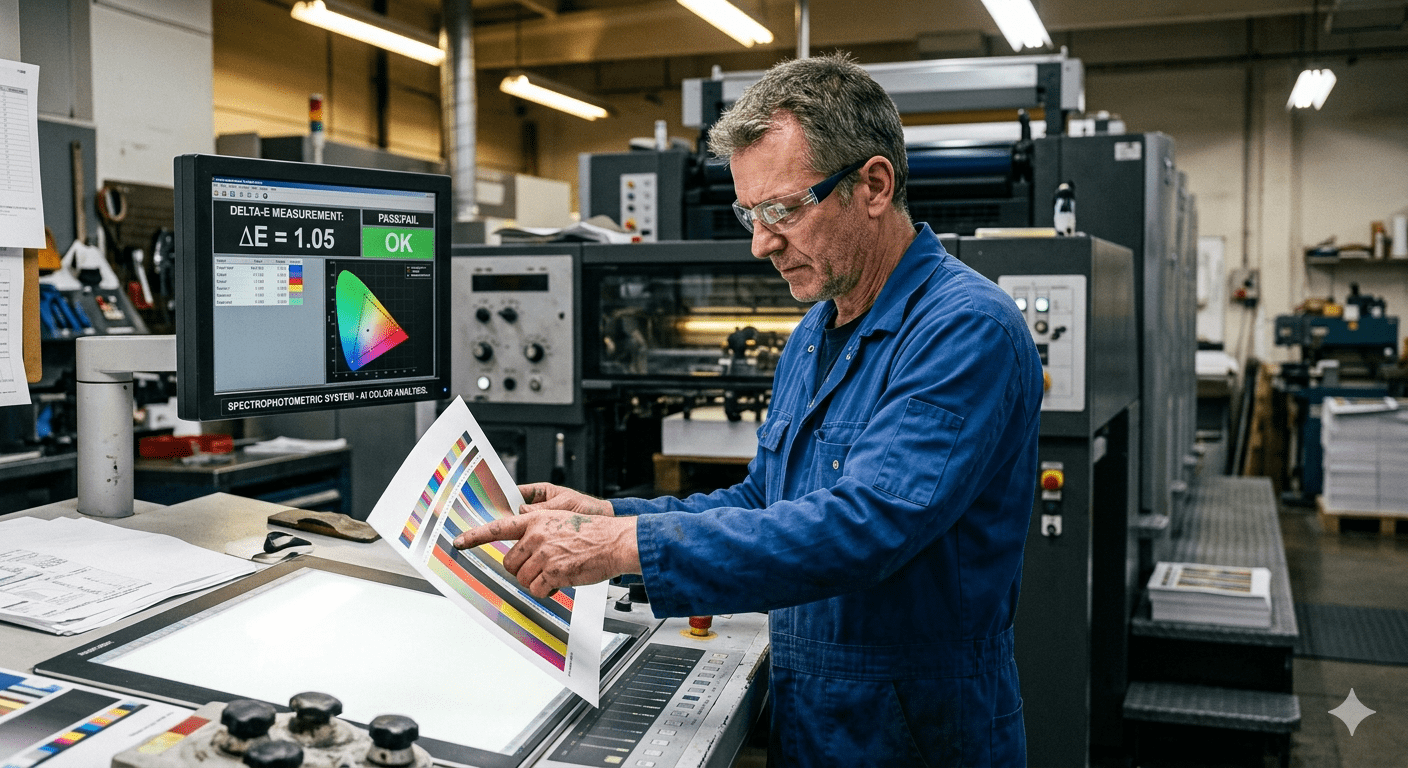
Just to be clear, the Master Printer’s Eye is not a scalable, transferable, or documentable asset.
It is a business asset.
ISO certification is not possible.
It is not repeatable in different shifts.
Furthermore, in a high-speed digital/offset hybrid production environment with 40–70 jobs per press per day, it becomes an active liability rather than a competitive advantage.
The demographic information is clear.
The professional workforce in the printing industry is arguably aging faster than professionals in other industries.
We are currently experiencing what workforce analysts call the “Silver Tsunami,” a wave of generational retirements that is robbing companies of their most important institutional knowledge.
It is estimated that a master printer with 25 years of experience in color judgment possesses about $2 million in ingrained knowledge related to printing technologies.
Unfortunately, their knowledge does not transfer to documents when they retire. It disappears.
This is made worse by the fact that the characteristics of the substrates on which they print can be very complicated.
The Four Hidden Variables of Subjectivity Cost
Extended Makeready Time: 25 to 45 minutes per shift, depending on operator skill level.
At a fully loaded machine cost of $185 per hour, this equates to $77-139 in direct waste per project before a single saleable print is generated.
Substrate Deterioration: 8-12% waste rate on specialty, synthetic, and recycled substrates with non-linear ink absorption curves.
This waste includes the total cost of all resources used during a failed print, not just the cost of the sheet itself.
Rejections and Reprints: When the ΔE variance goes over 2.0 or 2.5, brand-sensitive customers complain and may return your merchandise.
Reprints cause material costs, schedule disruptions, duplicate shipping, and relationship deterioration, which are rarely recorded as a single line item in the job cost.
Overtime and exceptional work: Experienced operators pulled out of the routine workflow to troubleshoot color exceptions result in hidden labor premiums of 20-30% above standard rates.
KEY INSIGHT
Under optimal conditions, human color perception has a maximum ΔE of around 2.5-3.0.
In a production facility, where we have mixed lighting, cognitive tiredness after a couple of jobs that are printed by a printer, and substrate variation on which we print, realistic detection thresholds are higher at ΔE = 4.0-5.0.
Your consumers’ brand criteria these days often require ΔE to be less than 1.5.
That difference represents your rejection rate.
AGENTIC COLOR MANAGEMENT ORCHESTRATION
How Neural Color Engines Differ from Legacy ICC Workflows
This is what most print technology companies won’t tell you.
The ICC profile framework is a static translation table, albeit a basic one.
It describes a device at a specific time, under specific substrate and environmental conditions, and shows how colorimetric conversions work between different states.
It can’t independently react to real-world press movement, material batch inconsistencies, or ink density changes during printing.
Your waste sits in the space between static profiling and the dynamic reality of production.
Agent-based AI color management systems operate on a fundamentally different architecture.
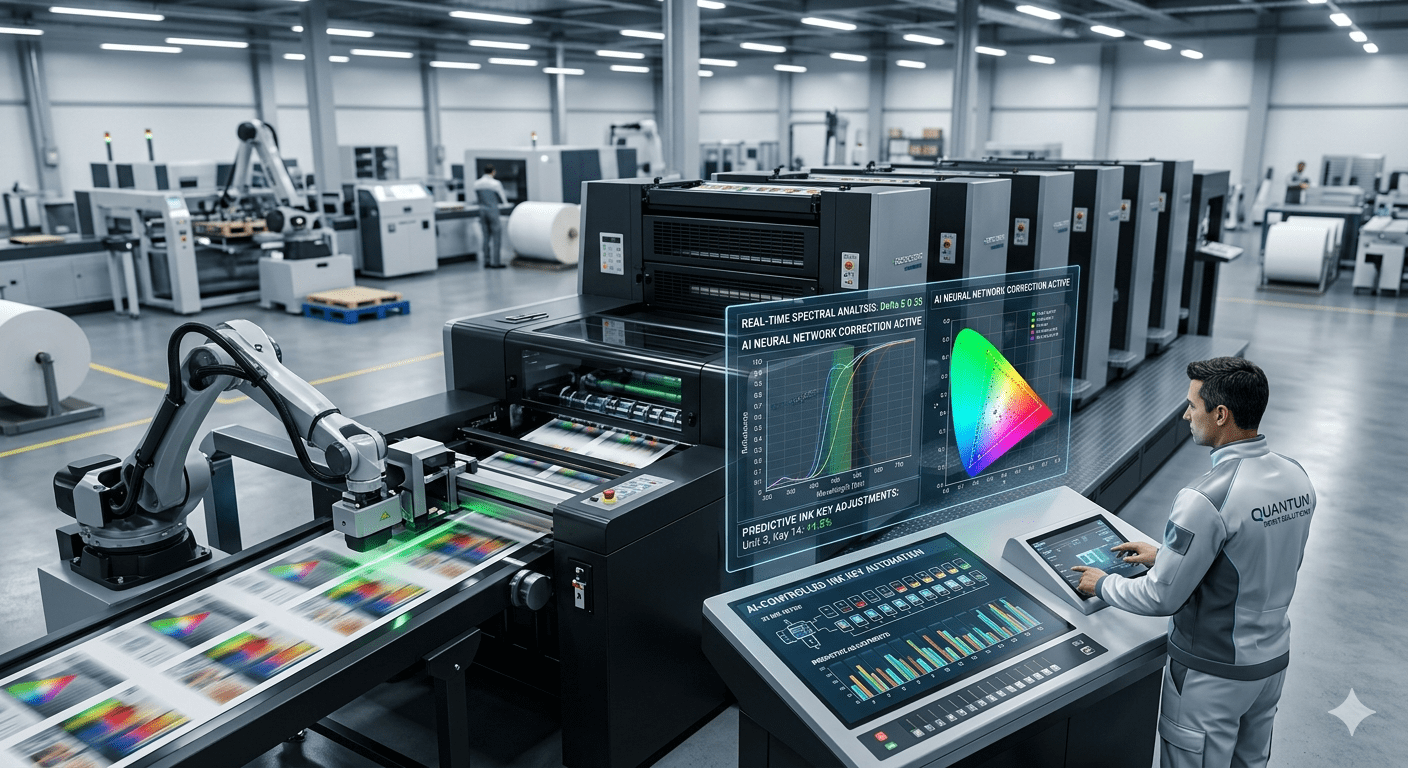
Instead of relying on a fixed LUT (Look-Up Table) structure, they use neural color engines that perform continuous spectral correction in a closed-loop feedback loop:
In-line Spectral Sampling: Inline spectrophotometers, such as X-Rite’s AI-powered print measurement sensors and Fiery Edge technology, collect spectral data on all sheets in the printing process, not just during prepress proofing.
This creates real-time L*a*b* readings for the entire print run.
Neural Network Deviation Analysis: The AI agent compares the live spectrophotometric data to the G7 Master Calibration targeted curves.
Deviations are classified by source (ink tack variation, roller temperature drift, OBA substrate run load), and a correction algorithm is selected from a pre-defined decision tree.
Autonomous predictive ink key control: Before the color difference reaches the threshold ΔE = 1.0, the system makes predictive ink key changes in all affected zones.
This is not a simple reactive color correction, but an anticipatory spectrum management.
Substrate-independent calibration: Agent systems retain neural models specific to the substrate being printed on.
When switching from 280 gsm uncoated board to 320 gsm high-quality GC1 glossy coated board, there is an automatic substrate profile handover.
No operator interaction, makeready extensions or other manual corrections.
The practical result of this architecture is device-independent color consistency.
When your print shop uses the same brand of ink on a fast production inkjet press and on an older 5-color offset press, this agent-based system achieves device-independence of color by referring to a common spectral target rather than device-dependent CMYK values as it used to be.
That’s what Substrate Independent Printing means in operational terms.
Delta-E < 1.0 on every surface: How neural engines achieve this value
The ΔE (Delta E) metric measures the visible difference between a target colour and printed output according to CIEDE2000 guidelines.
A ΔE below 1.0 is undetectable to the human eye.
Outdated manual methods result in ΔE variations of 3.0-5.0 on homogeneous substrates.
However, on recycled materials with varying OBA concentrations or synthetic materials with non-Lambertian reflectance, the range increases further.
Neural color engines maintain ΔE < 1.0 by operating across the entire spectrum, measuring over the wavelength range of 380-730 nm.
Tools like Fiery Edge technology incorporate this neural spectrum correction layer directly into the RIP operation, generating substrate-independent profiles that dynamically adapt to changing job conditions.
Negotiating Color Between Different Devices: Inkjet and Offset
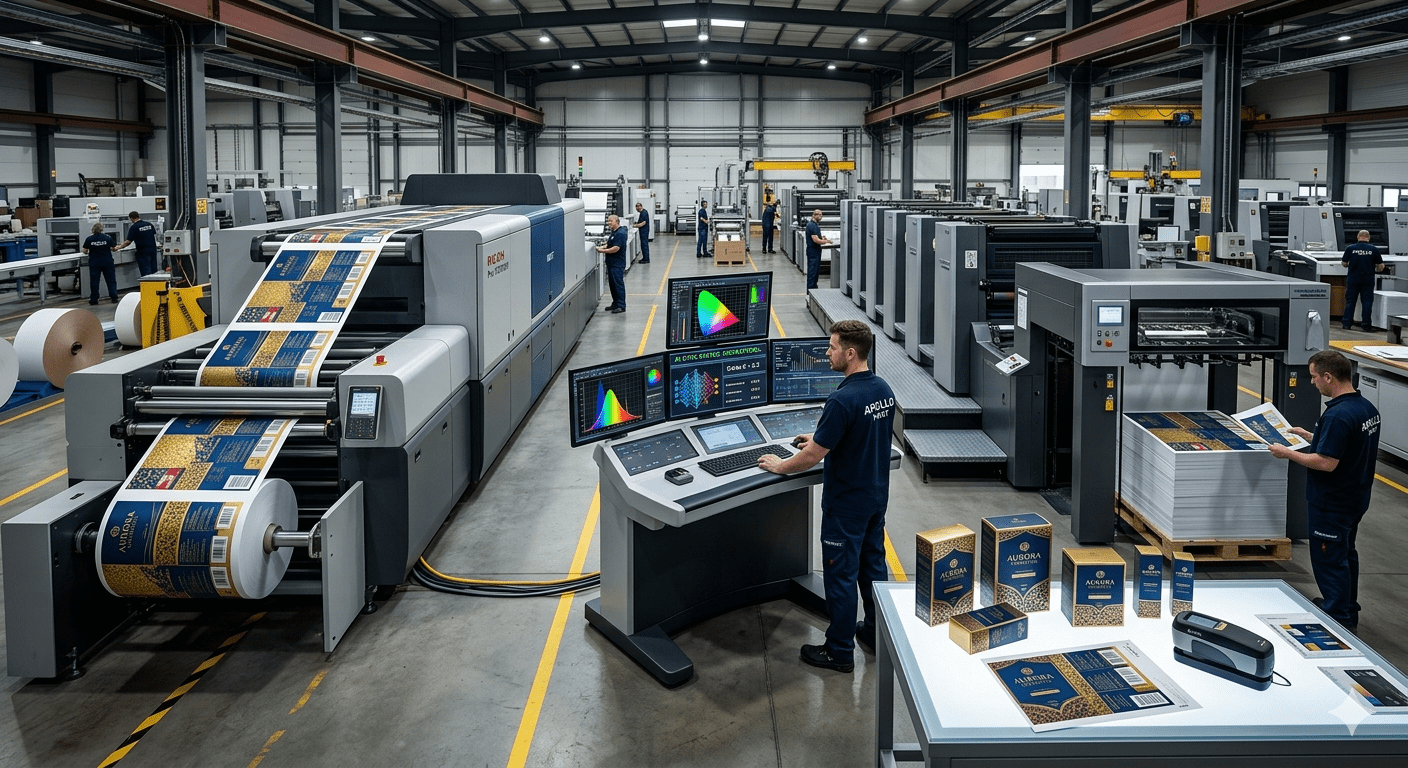
The biggest operational challenge in commercial printing in 2026 will be quietly matching high-speed inkjet output to the color of a traditional offset press, at a given job size.
An agent-based system does this continuously: an AI color agent continuously characterizes and monitors the states of both machines.
Calculates the transformation between the devices in real time.
And finally applies corrections to both platforms simultaneously.
The operator role evolves from color decision maker to exception manager and orchestration supervisor, a position that a junior technician can achieve with 12 months of training.
The ROI Data: Manual Color vs. Agentic AI Color Management
The following comparison is based on a hypothetical commercial enterprise – a medium-sized printing house with four printing lines (2 offset, 2 high-speed inkjet), 1.4 million prints per year, and a full-capacity printing cost of $185 per hour.
| Metric | Legacy Eyeball Method | Agentic AI Color Workflow | Impact on Margin |
| Make-ready Time | 25–45 Minutes | 4–7 Minutes | +12% Capacity |
| Substrate Waste | 8%–12% (Subjective) | <1.5% (Predictive) | -10% COGS |
| ΔE Variance | 3.0–5.0 (Visible) | <1.0 (Invisible) | Zero Rejections |
| Operator Skill | 10+ Years Experience | Junior (Orchestrator) | Solves Labor Gap |
| Ink Consumption | Manual / Reactive | Predictive / Spectral | -15% Ink Cost |
The CFO’s Formula: Waste Reduction ROI

Often when doing ROI analyses for printing, the same mistake is made: using substrate costs as a proxy for waste costs.
At $0.035 per sheet, substrate represents 12.7% of the actual cost of a failed print.
The table below shows the overall picture that your labor costing system already captures.
| Cost Component | $/Sheet (typical) | % of Total |
| Substrate (standard commercial cut-sheet) | $0.035 | 12.7% |
| Ink consumed per impression (process + specials) | $0.025 | 9.1% |
| Machine time @ $185/hr, 8,000 sph | $0.023 | 8.4% |
| Operator labor burden (allocated per sheet) | $0.012 | 4.4% |
| Pre-press / plating amortization | $0.180 | 65.5% |
| Fully-Loaded Variable Cost per Unit (Cs) | $0.275 | 100% |
KEY REVISIONS: Cs is redefined as the fully loaded variable cost per unit, which includes substrate, ink, machine time, labour, and pre-press amortisation.
This works out to about $0.275 per sheet for typical commercial offset.
This is what your MIS/ERP (Management Information System/ Enterprise Resource Planning) is already tracking. Use it.
The Formula
$$ ROI_{WR} = \frac{ (W_m – W_a)\cdot C_{s(fl)} \cdot V }{ I_t } \times 100 $$Where:
ROIwr – Return of Investment through waste
Wm – Manual Waste % (Historical Average, typically 8–12%)
Wa – Agentic AI Waste % (Target < 2%)
Cs(fl) – Fully-Loaded Variable Cost per unit: substrate + ink + allocated machine time + labor burden. Not substrate-only. Pull this from your MIS/ERP job costing report.
V – Annual Production Volume (total impressions/sheets run)
It -Total Investment in AI Color Tech (software licensing + integration + commissioning)
Worked Example: Standard Commercial Printing Shop
$$ ROI_{WR} = \frac{ (0.10 – 0.015)\cdot 0.275 \cdot 1400000 }{ 120000 } \times 100 $$ $$ ROI_{WR} = 27.3\% $$| Scenario | Cs (Fully Loaded) | Annual Savings | ROI-WR | Payback |
|---|---|---|---|---|
| Standard commercial offset | $0.275 | $32,725 | 27.3% | ~4.4 years |
| Recycled/uncoated specialty | $0.65 | $77,350 | 64.5% | ~1.6 years |
| Synthetic/premium packaging | $1.40 | $166,600 | 138.8% | <1 year |
Assumptions (all scenarios): Wm = 10% | Wa = 1.5% | V = 1,400,000 sheets | It = $120,000
For a conventional commercial offset priced at Cs = $0.275, ROI-WR = 27.3%,a full return on capital is in about 4.4 years.
This is a reasonable and defendable figure.
For synthetic materials or premium packaging at $1.40 per sheet, the ROI-WR is 138.8%, with a return on investment of less than a year.
90-Day Implementation Plan
Structured to be implemented without interruption to production.
Parallel work during Phase 2.
Phase 1 extracts fully-loaded costs (direct materials + direct labor + overhead) from MIS/ERP – this provides a clear picture of the return on investment.
| Phase | Milestone | Key Actions | Deliverable |
| Days 1-30 | Diagnostic & Baseline | Implement X-Rite i1Pro 3 plus spectrophotometers on all printing lines. Generate full spectral characterization of all substrates in production rotation. Establish G7 Master calibration baselines. Quantify current Delta-E variance per operator. Extract fully loaded Cs from MIS/ERP job costing data. | Spectral data foundation + CFO-ready cost baseline |
| Days 31-60 | AI Engine Integration | Integrate Fiery Edge with a neural engine layer for color. Connect spectrophotometer data to an API for real-time ink keying. Run parallel work: AI system versus legacy visual method on identical jobs. Measure Delta-E divergence and waste generation daily. | Proof-of-concept data for CFO sign-off |
| Days 61-90 | Autonomous Handoff | Transfer ink-key authority from senior operators to AI orchestration system. Adapt experienced printers for exception management. Activate predictive spectral correction across hybrid fleet (inkjet + offset). Prepare the first ROI report for the C-suite, including a live margin delta versus the Cs baseline. | Fully autonomous workflow; ROI-WR proven in production |
Strategic Conclusion
In 2026, emotions are not a sustainable business approach.
The silver tsunami greatly impacts the quality and expertise you lose as your experts leave, a process you cannot control.
Without any optimistic assumptions, the financial economics of waste, when properly calculated with fully loaded Cs inputs, give you a strong argument for implementing color management via agent-based AI.
Agent-based AI does not replace craftsmanship, it institutionalizes it.
The neural color engine encodes the spectral intuition of your best operators and executes it at machine speed, 24 hours a day, without fatigue, variance, or retirement age.
Frequently Asked Questions: AI Color Management & ROI
Why is the traditional “Eyeball Method” becoming a financial liability?
As experienced master printers retire during the “Silver Tsunami,” their subjective color knowledge disappears. Relying on manual vision leads to 25–45 minute makeready times, 8–12% substrate waste, and an average 12% margin bleed that modern print shops simply cannot afford.
How much can Agentic AI reduce makeready time and waste?
By using neural color engines and predictive ink-key control, Agentic AI drops press preparation time to under 7 minutes. More importantly, it reduces substrate waste to less than 1.5% while maintaining a Delta-E (ΔE) variance of less than 1.0.
What is the realistic ROI of implementing Agentic AI Color Management?
When calculating fully-loaded variable costs (including ink, machine time, and labor), a standard commercial offset shop can expect an ROI of around 27.3% (approx. 4.4 years payback). For shops running premium packaging or synthetic materials, the ROI jumps to over 138% with a payback period of less than a year.
Can AI synchronize colors between legacy offset and new inkjet presses?
Yes. Agent-based AI systems achieve Substrate Independent Printing by continuously characterizing both machines and calculating real-time transformations. This ensures undetectable color variance across a hybrid production fleet.