It’s 4:47 PM on a Friday in Manchester.
The presses are scheduled to run overnight on a £12,000 pharmaceutical packaging job.
Your production manager calls: the client’s PDF has transparency flattening issues and a spot colour that will separate incorrectly.
Your last prepress technician with lithographic training left three months ago.
The two juniors you hired can operate the software, but they don’t understand trapping, ink coverage limits, or how CMYK builds behave on coated stock.
You’re looking at weekend overtime, potential reruns, and a margin that just evaporated.
This scenario is playing out across printing facilities in Birmingham, Brooklyn, and Brisbane every single day.
The Silver Tsunami—the mass retirement of skilled workers born between 1946 and 1964—has gutted the prepress department.
In the UK alone, industry surveys indicate that the average age of people in the printing industry in 2024 was calculated at 43.4 which is worrying factor.
The U.S. Bureau of Labor Statistics projects that employment of prepress technicians will decline by 14.6% from 2024 to 2034, a contraction driven directly by the shift to automated workflows and digital technologies.
Australia faces similar attrition, compounded by immigration policy changes that have restricted skilled trade visas.

The consequence?
Manual file-checking has become the primary bottleneck in commercial print operations.
What AI prepress automation offers isn’t a wholesale replacement of human judgment—it’s the systematic elevation of remaining staff into higher-value roles while eliminating the repetitive, error-prone tasks that once required decades of training.
The Prepress Bottleneck: Why Manual Workflows Are Failing
Traditional prepress departments functioned as quality gatekeepers.
A skilled technician would open each incoming file, visually inspect images for resolution and colour space compliance, check bleeds, verify fonts, assess ink coverage, and apply job-specific settings for trapping, screening, and output.
This process required not just software proficiency but deep understanding of offset lithography, flexography, or digital press behaviour.
In 2026, that expertise is vanishing.
The technicians who remain are overwhelmed.
A mid-sized commercial printer processing 200-400 jobs monthly cannot afford the 15-25 minutes of manual checking each file demands.
Mistakes slip through: a low-resolution logo that looked acceptable on-screen produces visible pixelation at press speed.
A rich black build exceeds the press’s total area coverage limit, causing setoff.
An RGB image that wasn’t converted to CMYK renders with unexpected colour shifts.
These errors don’t just cost money in reprints and substrate waste.
They erode client confidence and destroy margins that are already compressed by rising substrate costs (up 17% since 2024) and energy expenses.
The prepress bottleneck has become an existential threat to operational efficiency.
The problem isn’t that junior staff lack intelligence or work ethic.
They lack the pattern recognition that comes from seeing ten thousand jobs across two decades.
They don’t instinctively know that a particular shade of blue will shift on uncoated stock, or that certain PDF export settings from legacy design software create unreliable transparency handling.
You can’t train that intuition in six months.
Agentic AI: Content-Aware Automation That Understands the Job
This is where the fundamental shift occurs.
Previous generations of prepress automation relied on metadata and rules-based logic.
If the filename contained “business card,” apply preset A.
If the page size was A4, route to queue B.
Functional, but limited.
Agentic AI systems analyse actual content.
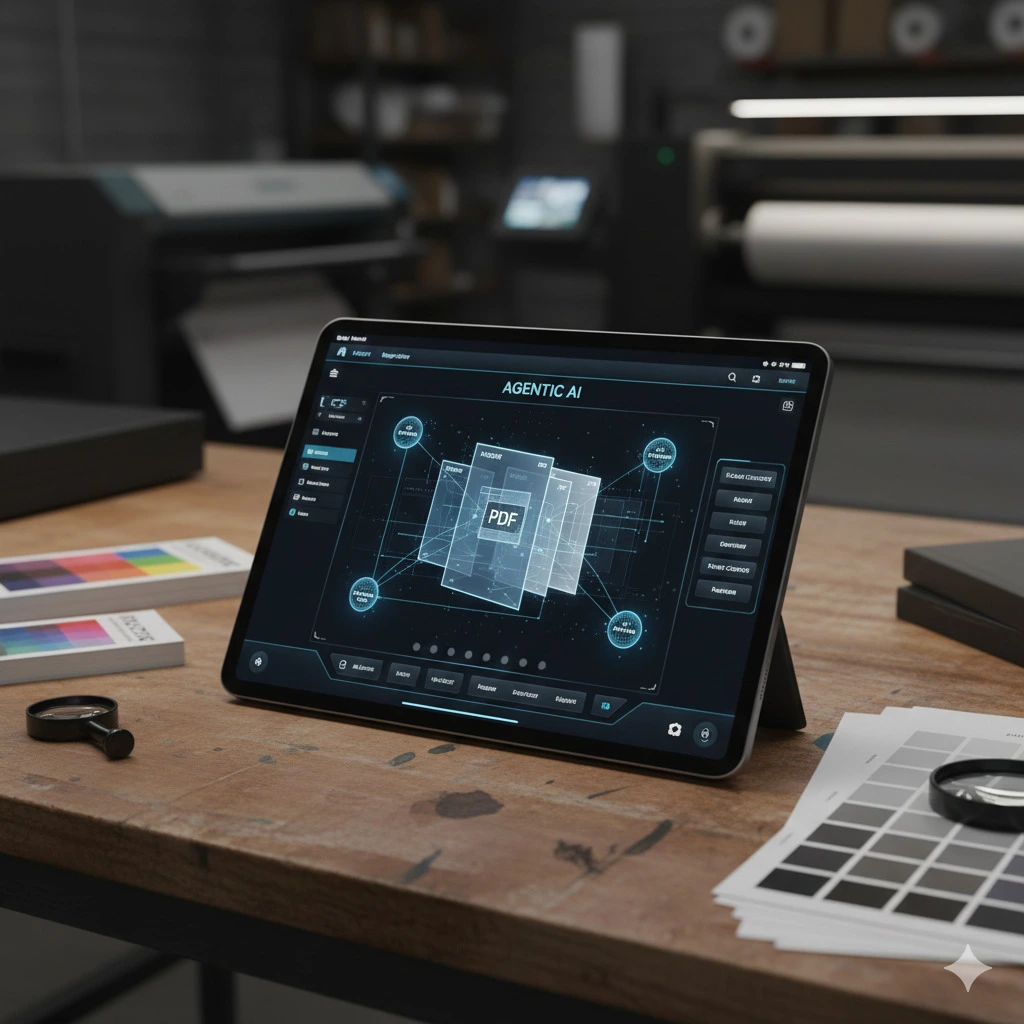
They employ computer vision algorithms to examine the PDF’s visual structure, identify image resolution in context (a background texture can be 150 DPI; a product photo cannot), detect colour space inconsistencies, assess font embedding status, and evaluate bleed sufficiency relative to trim marks.
Critically, they make decisions based on what the job is, not just what the metadata claims it is.
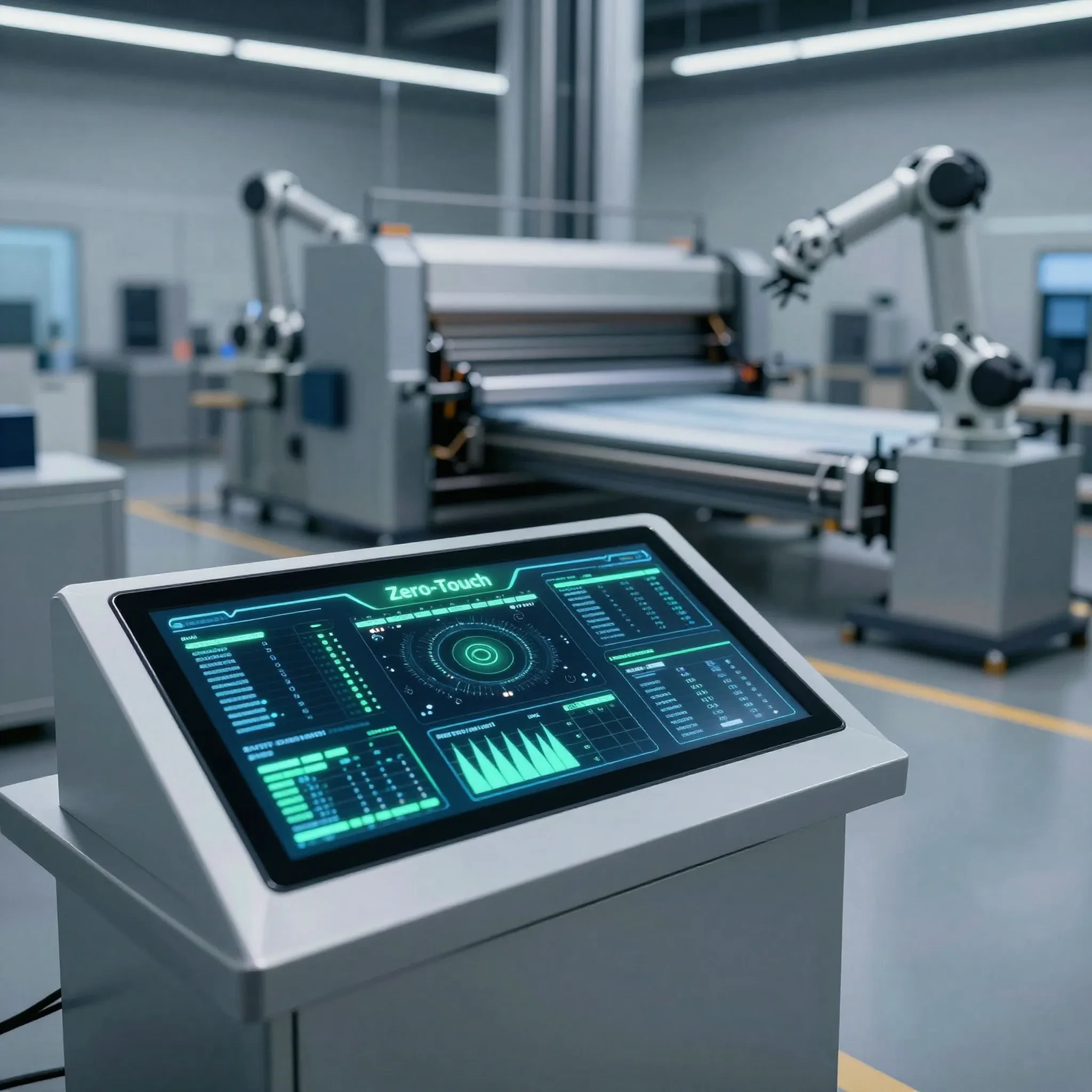
EFI’s Fiery JobFlow Pro, launched on February 3, 2026, represents the current benchmark in this category.
Unlike its predecessors, JobFlow Pro integrates AI-driven content interrogation directly into the routing engine.
When a PDF enters the workflow, the system doesn’t just read job tickets—it visually analyses page content to determine whether the file is a business card, a booklet, or a wide-format banner.
It then applies appropriate preflighting criteria, selects press-specific colour management profiles, and routes the job to the optimal output device.
The impact is measurable.
Beta sites reported 68% reduction in prepress touch-time and 81% fewer customer service calls related to quality issues.
Jobs that previously required manual intervention now flow directly to press-ready status without human review.
| Feature | Traditional Manual Prepress | Standard Rule-Based Automation | Zero-Touch AI (Fiery JobFlow Pro) |
| Labor Requirement | High (Senior Specialist) | Medium (Trained Operator) | Low (Junior / AI-Supervised) |
| Avg. Time per File | 12 – 15 Minutes | 3 – 5 Minutes | < 30 Seconds |
| Error Detection | Subjective / Human Error | Rules-Only (Binary) | Contextual / AI-Assisted |
| Scalability | Limited by Headcount | Fixed by Logic | Infinite / Event-Driven |
| Skill Gap Risk | Critical (Silver Tsunami) | Moderate | Mitigated via AI-Language |
| 2026 Cost per Job | $8.50 – $12.00 | $4.00 – $6.00 | $0.85 – $1.20 |
PDF Interrogation and AI Preflighting: Seconds, Not Minutes
Adobe Sensei, integrated into Acrobat Pro and InDesign Server workflows, now performs real-time analysis of placed images, fonts, and colour objects.
When a designer places a 72 DPI screenshot into a brochure layout, Sensei flags it immediately with contextual guidance: “This image will print at 12 DPI at final output size—replace with 300 DPI minimum.”
Fiery JobFlow Pro extends this capability into production environments.
Its preflight engine examines every object on every page, comparing against press-specific tolerances.
Low-resolution images, missing fonts, incorrect colour spaces, insufficient bleed, and excessive ink coverage are detected in 3-8 seconds per file, compared to 12-20 minutes for manual inspection.
Enfocus PitStop (AI feature is called “Botus”), the latest iteration of the industry-standard PDF editing tool, now includes neural network-based anomaly detection.
It identifies patterns that human operators might miss: subtle colour shifts between pages that indicate a design software bug, inconsistent spot colour definitions that will cause registration issues, or transparency flattening errors that only manifest on certain RIP configurations.
The system learns from corrections.
When an operator manually fixes a recurring issue—say, converting a specific Pantone colour to a CMYK build because the shop doesn’t stock that ink—PitStop AI observes the pattern and proposes the same correction automatically on future jobs.
This isn’t rigid automation; it’s adaptive intelligence that incorporates institutional knowledge.
The Connected Print Shop: Industry 4.0 and Real-Time Triggers
Modern prepress automation doesn’t exist in isolation.
It functions as part of an Industry 4.0 architecture where machines, software systems, and workflow components communicate via standardised protocols.
MQTT (Message Queuing Telemetry Transport), the lightweight messaging protocol originally developed for oil pipeline monitoring, has become the de facto standard for print IoT integration.
When a digital press completes a job, it publishes an MQTT message.
The prepress system receives that event and automatically initiates preflighting on the next queued job.
When the large-format printer reports low ink in cyan, the system re-routes jobs requiring heavy cyan coverage to an alternative device.
GelatoConnect, the cloud-based production platform, uses this architecture to create geographically distributed “virtual print facilities.”
A job submitted in London can be automatically preflighted, colour-managed for the destination press profile, and routed to a production partner in Manchester—all without human intervention.
The prepress intelligence travels with the file.
This event-driven approach eliminates the constant manual monitoring that once consumed production coordinators’ time.
The system reacts to real-world conditions (substrate availability, press status, job priority changes) in milliseconds, not hours.
Why AI Won’t Fire Your Prepress Team—It Will Multiply Their Effectiveness
Here’s the counter-intuitive truth that most automation vendors won’t tell you: AI prepress systems don’t eliminate headcount.
They transform junior operators into senior-level contributors within months instead of years.
Consider the typical skill development curve.
A new prepress operator spends 18-24 months learning to identify common errors, understand press limitations, and develop judgment about when to push back on client files versus when to apply corrective fixes.
During that period, their work requires constant supervision and generates occasional costly mistakes.
With AI-driven automation handling routine detection and correction, that same junior operator now focuses on exceptions, client communication, and process optimisation.
The system flags potential issues and suggests fixes; the operator approves, refines, or escalates.
They’re making senior-level decisions from day one because the AI has eliminated the cognitive load of routine pattern recognition.
Use of AI Prepress Systems in Practice
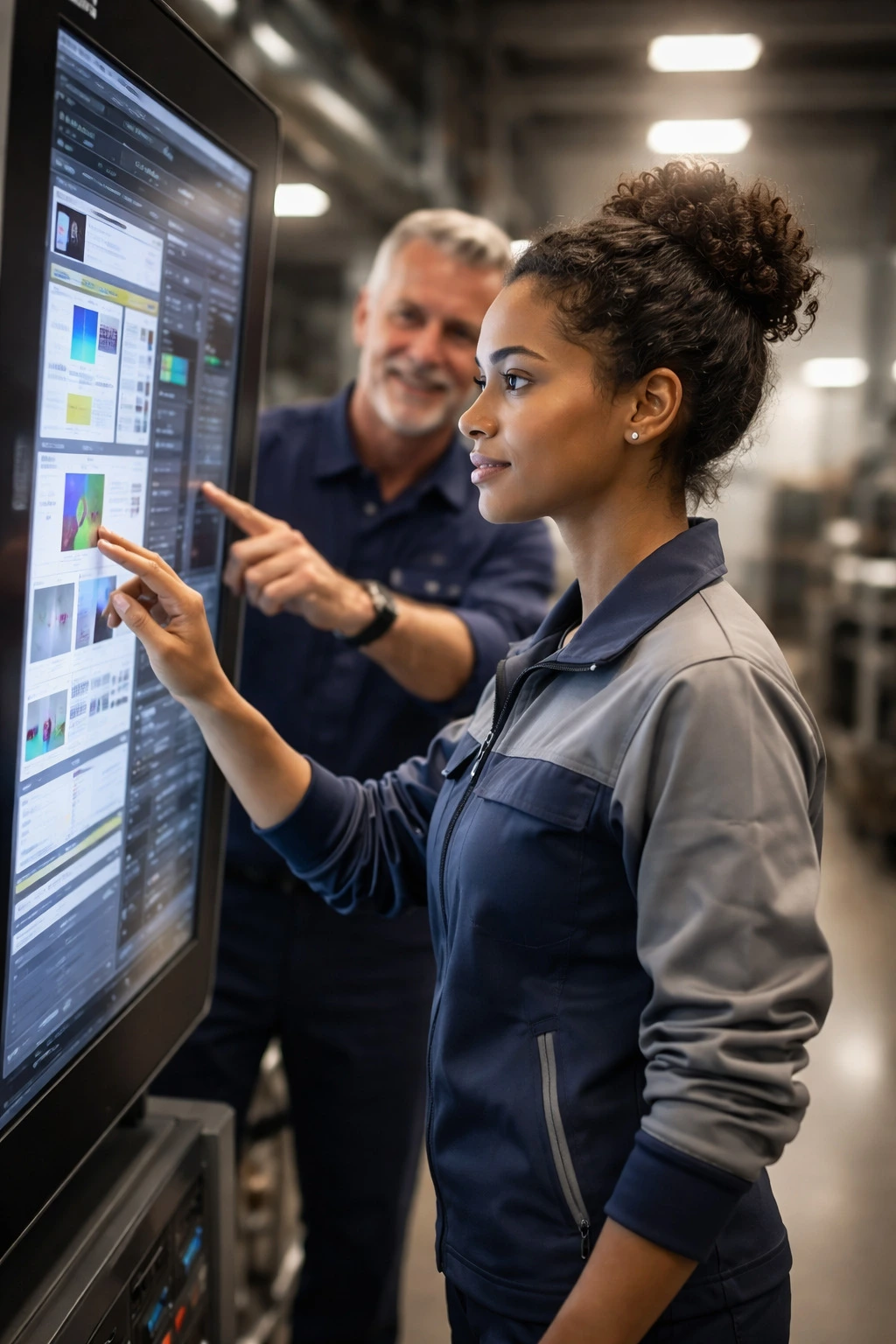
A commercial printer in Sydney implemented Fiery JobFlow Pro in December 2025.
Their prepress department consisted of one senior technician (approaching retirement) and two junior staff with less than 12 months experience.
Within six weeks, the junior operators were handling 90% of jobs independently.
The senior technician transitioned to colour management strategy and client consultation—higher-value work that directly impacts profit margins.
It is good to know that Fiery JobFlow Pro uses a “Private LLM” approach for its AI capabilities, designed to protect customer data and proprietary information.
Similar success has been reported at mid-sized packaging houses in Chicago and the English Midlands, where ‘Lights-Out’ shifts are now the standard for 10 PM – 6 AM production.
The labour crisis hasn’t disappeared, but its impact has been neutralised.
You still need intelligent humans in the loop.
You just need fewer of them, and they don’t need 20 years of experience to be effective.
Strategic Imperatives: The 15% Margin Mandate
In the current economic environment—substrate costs up 17%, energy expenses up 22%, wages increasing 8-12% annually—maintaining a 15-20% operating margin requires structural change, not incremental efficiency gains.
Manual prepress operations typically consume 12-18% of total production costs when you account for labour, software licensing, error correction, and rework.
Zero-touch workflows reduce this to 4-7%.
That margin recovery directly impacts profitability.
More importantly, lights-out automation creates capacity without capital expenditure.
The same staff can process 200% more jobs.
You don’t need to buy another press or lease additional facility space.
You’re extracting more revenue from existing assets.
CFOs understand this calculation.
A £180,000 investment in workflow automation (software, integration, training) that eliminates 40 hours of weekly manual labour at £28/hour generates ROI in 14-16 months.
The payback accelerates when you factor in reduced rework, faster turnaround enabling premium pricing, and the ability to accept jobs you would previously have declined due to capacity constraints.
The 2026 Technology Stack: Specific Tools for Specific Outcomes
Building a zero-touch workflow requires integration of best-in-class components:
Core Workflow Automation: Fiery JobFlow Pro (content-aware routing, AI preflighting) or Enfocus Switch (rules-based automation with AI enhancement modules).
PDF Intelligence: Adobe Acrobat Pro with Sensei integration for design-phase catching, plus Enfocus PitStop AI for production-level correction.
Colour Management: X-Rite i1Profiler with SpectralVision for press characterisation, integrated with GMG ColorProof for soft proofing and remote approval.
Cloud Integration: GelatoConnect for distributed production networks, or HP PrintOS for facilities running HP Indigo digital presses.
Analytics and Optimisation: Avanti Slingshot or PrintVis ERP systems with real-time job costing and margin analysis.
The key is interoperability.
These systems must exchange data via JDF (Job Definition Format), MQTT, or RESTful APIs. Proprietary silos destroy the efficiency gains that integration promises.
Implementation Reality: The 90-Day Transition Framework
Deploying AI prepress automation isn’t a software installation—it’s a process redesign.
Successful implementations follow a structured approach:
Days 1-30: Audit current workflows.
Document every touchpoint, decision point, and exception handling process.
Identify the 20% of job types that consume 80% of prepress time.
Days 31-60: Configure automation rules for the high-volume, low-complexity jobs first.
Build confidence with quick wins before tackling complex work.
Days 61-90: Train staff on exception handling and system oversight.
Transition senior technicians into quality assurance and continuous improvement roles.
The facilities that fail are those that expect to switch on AI and walk away.
The ones that succeed treat it as a partnership between human expertise and machine consistency.
Conclusion: Automate or Concede
The 2026 print landscape offers a binary choice.
Industry analysts at Quocirca predict that 2026 is the tipping point where AI maturity separates the leaders from the laggards.
Facilities that implement zero-touch prepress workflows will capture market share from competitors still relying on manual processes.
They’ll deliver faster turnarounds, more consistent quality, and better margins.
Those that cling to traditional methods will face escalating costs, quality inconsistencies, and client defection.
The Silver Tsunami isn’t reversing.
Skilled lithographic technicians aren’t returning to the workforce.
AI prepress automation isn’t a future consideration—it’s the current requirement for operational viability.
The technology exists.
The business case is proven.
The only remaining variable is leadership conviction to execute the transition before margin compression becomes terminal.