Why Bio-Derived Chemistry is a Margin Strategy, Not a Compliance Cost
Executive Summary
Let’s discard this concept right now.
The concept that bio-based inks are a net margin penalty—a cost per item that must be paid in the name of corporate social responsibility—is not only outmoded.
It is operationally risky.
It belongs in the same trash bin as businesses that still modify their ink fountain keys “by eye” and call it good enough.
The procurement logic that considered sustainable chemistry as a some philanthropic premium ended sometime between 2022 and 2023.
That’s when oil supply chain volatility transitioned from a quarterly footnote to a permanent structural danger. Brent Crude swings by 30% to 40% during a single fiscal year.
There are chronic solvent feedstock shortages.
Hazardous waste removal fees are constantly increasing.
Each of these factors is inextricably linked to the true cost of petroleum-based inks.
The issue is that most print finance teams do not track them with the granularity that they should.
Here’s the structural reality of 2026: The biological chemistry of vegetable oils provides a sophisticated substitute for the danger of fossil fuel shocks, as well as a tool for lowering total cost of ownership (TCO).
Value is realized across regulatory compliance, substrate usage, waste reduction, and—most importantly—winning corporate contracts.
This is just a floor, not a ceiling. A minimal entrance cost.
Tier one packaging buyers have pushed the envelope.
They want supply chain transparency, confirmed data on ink removability, and validated ultra-low VOC chemistry—all documented before the RFP is even closed.
Bottom line: Printing companies that continue to use out-of-date mineral chemistry in 2026 aren’t only losing money.
They purposefully disqualify themselves from the most lucrative packaging contracts on the market.
Hidden Petrochemical Costs and Contract Loss
The visible cost of purchasing ink is almost never an issue.
What you don’t see is what eats into your bottom line.
Petroleum-derived formulas – made from mineral oils, aromatic solvents and hydrocarbon resins – contain volatile organic compounds (VOCs) that typically range from 20% to 35% of the total weight of the ink.
These VOCs don’t just evaporate harmlessly into the ether.
They trigger strict air permit compliance thresholds under regional environmental regulations that now exist in nearly every state.
Managing this requires robust extraction systems, air permit renewals, stack testing, Continuous Emissions Monitoring Systems (CEMS) calibration, and third-party audits.
None of this appears on your raw ink invoice, and it really should.
All of this is buried in the printer’s unallocated overhead costs, making the true cost per print structurally opaque and difficult to determine when it comes to petrochemical printing inks.

Then there’s the hazardous waste stream.
The solvent-rich wash solutions used to wash offset press blankets and rollers are classified as hazardous materials in almost every jurisdiction.
We are witnessing a skyrocketing increase in waste disposal costs as industrial waste disposal and incineration capacities are increasingly reducing.
Ultimately, three-shift production in medium to high-volume printing generates a huge annual solvent disposal liability.
It is a liability and expense that is rarely attributed and associated with purchasing decisions about “cheap” inks.
Deinkability: The Contract Killer Nobody Talks About
This is an operational blind spot that completely surprises commercial printers.
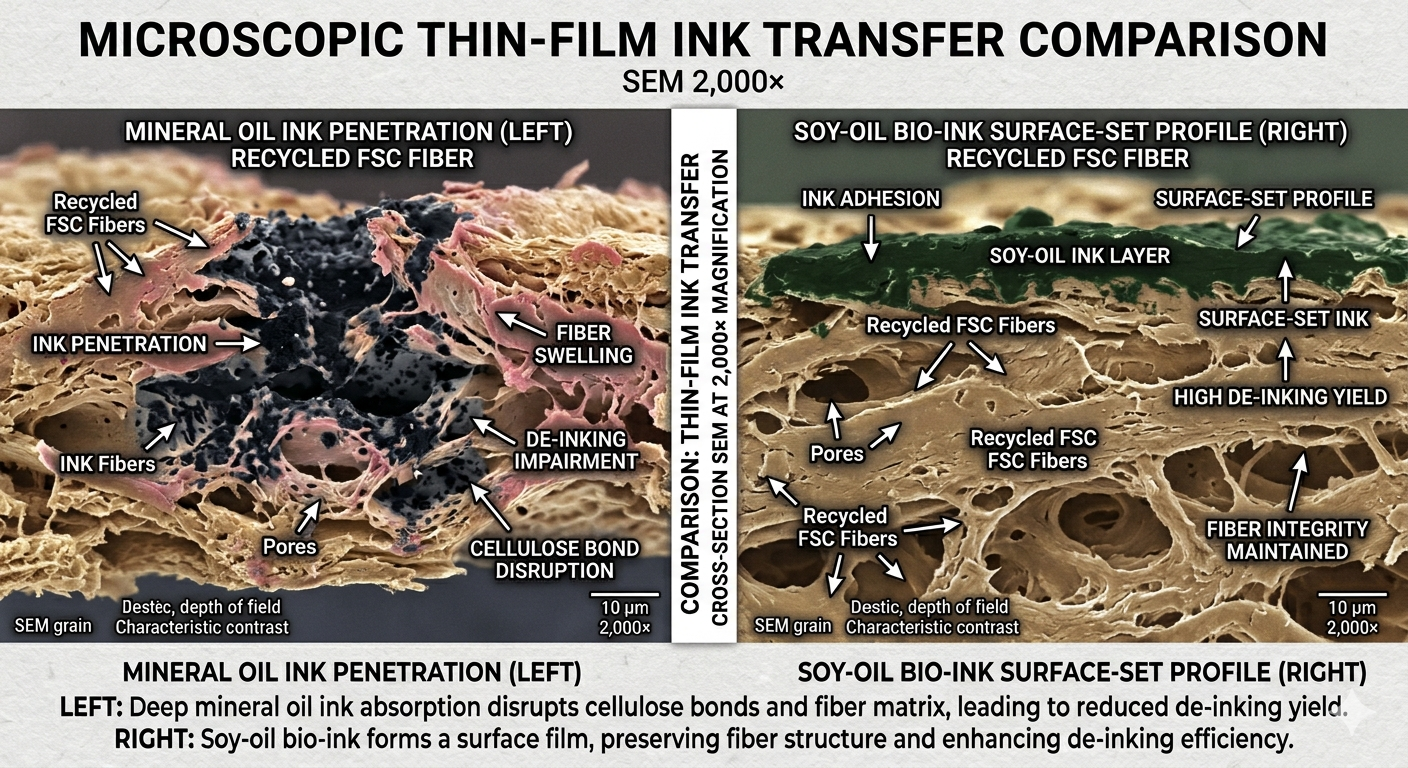
Mineral oils from petroleum aggressively bind to cellulose fibers during the printing cycle.
The hydrophobic character of the ink – the very property that allows it to resist water absorption on the printing press – works disastrously against it during the pulping phase of the recycling cycle.
When the printed material reaches the recycling plant, the high concentration of mineral oil in the ink drastically complicates the process of removing the ink, contaminating the fiber mixture.
This normally increases processing costs.
Factories return these costs to the price of the substrate.
In the end it goes back to your profit and loss account.
The commercial benchmark that governs this is the International Deinking Industry Association (INGEDE) Method 11 protocol.
This is a standardized laboratory test protocol used to assess the deinking ability and overall recyclability of printed paper products.
This laboratory flotation simulation scores printed samples against five critical parameters:
Luminosity (ISO Brightness): Measures the brightening effect of ink removal.
Color: Checks for unwanted color changes (e.g. green/yellow shade) that can be caused by residual ink.
Cleanliness: Evaluates visible dirt stains using different particle size classes.
Ink Elimination Index: Indicates the overall efficiency of ink removal.
Filtrate Darkening: Evaluates the color change and contamination of the process water.
The scoring threshold that dictates commercial viability is a “Good Deinkability” rating of greater than 71 points on the EPRC (European Paper Recycling Council) Deinking Scorecard.
Major packaging buyers now specify this threshold explicitly in procurement RFPs.
This is especially true for brand owners bound by strict circular packaging commitments or EU-aligned sustainability mandates.
Here is the thing. Legacy petroleum inks routinely score a miserable 40 to 60 points on INGEDE Method 11.
Meanwhile, advanced bio-derived ink formulations—specifically those engineered on linseed, soy, and canola oil chemistry baselines—consistently smash the metric at 85 to 95+ points.
You understand that this distinction cannot be a topic of conversation for green marketing.
It is a strict, binary gate of your pass/fail on the corporate bid requirements.
If you fail it, your bid is dead before technical review.
You’re out. Full stop.
The Molecular Advantage: Tack, Transfer, and Optical Density
Historically, the print industry assumed that ‘environmentally friendly’ meant compromised quality, but…
Vegetable oils carry long-chain fatty acid molecular structures.
These are inherently superior solvating agents for pigment dispersion compared to the short-chain aliphatic hydrocarbons found in mineral oil.
Simply put, they wet pigments more efficiently.
This molecular efficiency translates directly into higher pigment loading per unit of material.
Your printing team can achieve identical or even superior optical density targets with measurably thinner ink films.
The numbers: Bio-derived formulas allow printers to work with average ink film thicknesses ranging from 0.9 to 1.1 microns, compared to the 1.2 to 1.5 microns that is typically required for petroleum inks to achieve the same target density.
Return on investment: This 20% to 25% reduction in film thickness gives an overall increase in consumption of up to 12% per kilogram of ink consumed.
In large volumes – in operations processing tens of thousands of kilograms per year – this fully compensates for the difference in raw ink cost in the initial price.
Lithographic Stability: The Ink-Water Balance Window
On a lithographic offset press, the ink-water balance window is your entire world.
Oil-based inks, especially on high-speed prints at elevated fountain solution temperatures, have a bad tendency to emulsify.
Water seeps into the ink body, reducing adhesion, compromising transfer, and inviting the holy trinity of printer nightmares: layer build-up, roller glazing, and hickeys.
Spending an hour chasing hickeys on a 8-color offset printing press is pure margin destruction.
Bio-derived vegetable oils have a fundamentally wider ink-water balance window.
The ester bonds in the fatty acid chains resist water uptake under harsh manufacturing conditions.
They maintain stable tack and transfer profiles even when fountain solution conductivity and pH fluctuate in the production process.
For long runs and extended overnight shifts, this stability is no small luxury – it’s the difference between a flat, profitable density curve and a wasteful preparation spiral.
Performance and Dot Gain Control Independent of the Substrate Being Printed on
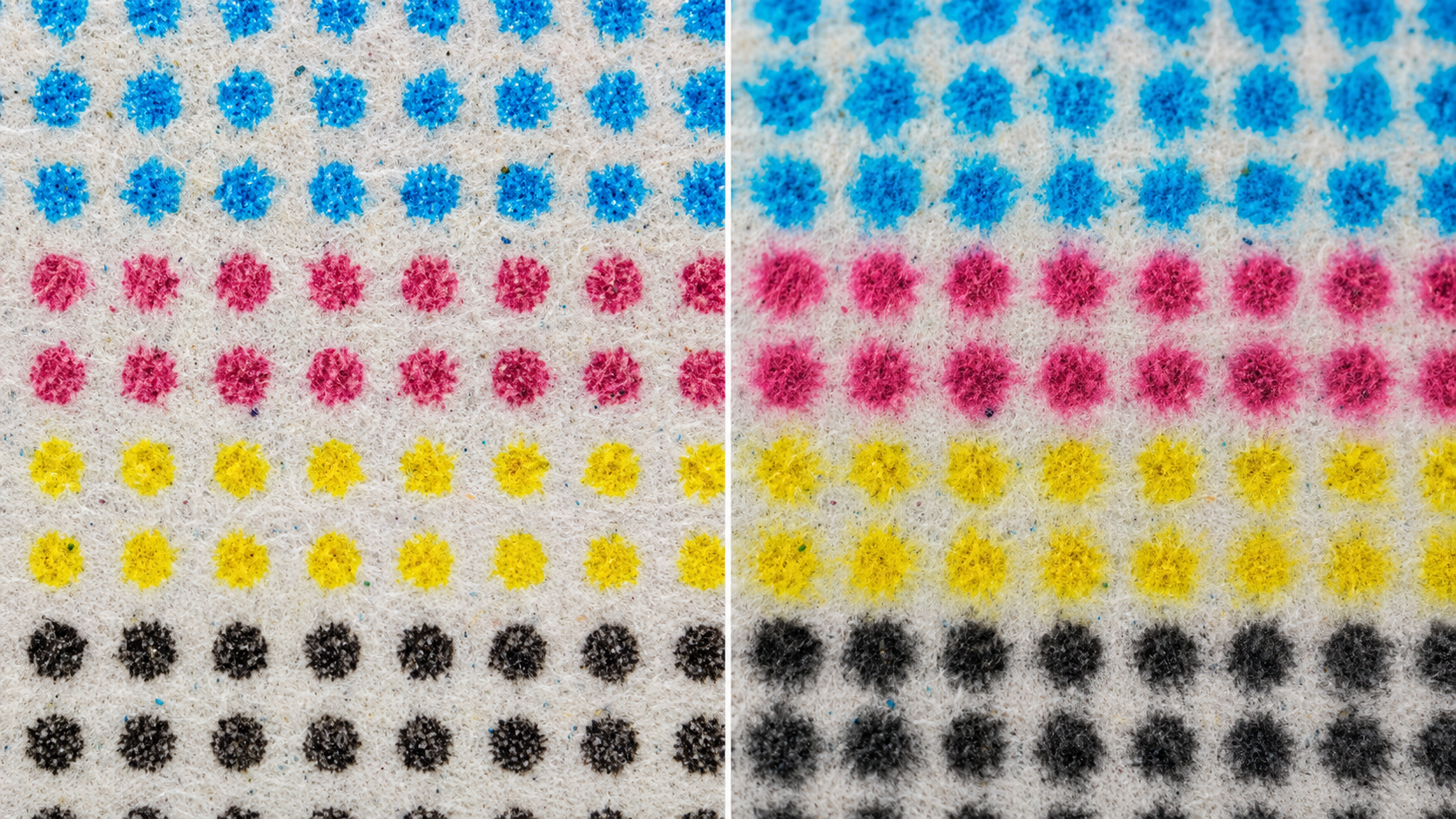
Porous recycled FSC papers and lightweight uncoated papers pose a major problem with dot growth when using mineral oil inks.
The low viscosity of mineral oil leads to aggressive lateral fiber penetration upon contact, causing variations in dot spread to exceed the target value by 8% to 12%.
This reduces shadow detail and destroys tonal compression in critical color zones.
Bio-inks use their higher molecular weight to cure rapidly on the surface of porous papers, controlling the penetration rate and holding the dot geometry firmly.
The measurement of volatile content in all of these chemical compositions is strictly regulated by ASTM Test Method D6419-00(2023) – a precise analytical standard that your compliance team and color suppliers must refer to.
The Financials: The Bio-Derived Transition ROI Formula
CFOs don’t care about environmental sentiment; they care about arithmetic.
Here is the exact economic framework structured for your next board presentation:
Itransition
Variable Definitions for the P&L Audit:
Itransition = One-time implementation costs (roller compatibility durometer audits, washup chemistry changeover, and prepress curve linearization).
V = Annual print volume processed (expressed in total impressions or kilograms of substrate).
Mpremium = The net margin premium captured per unit by offering certified carbon-neutral or bio-derived printing to tier-one enterprise brands.
Sreg = Total structural savings from reduced VOC compliance monitoring, lower facility insurance premiums, and the elimination of hazardous solvent disposal fees.
Swaste = Substrate and ink savings achieved via rapid ink-water balance during makeready combined with the 12% per-impression mileage gain.
ΔCink = The raw ink purchase price delta (Annual Bio-ink cost minus Legacy Petroleum-ink cost).This is the only number the legacy procurement mindset tracks. As the formula proves, it is an incomplete data point.
Performance & Economic Benchmark
| Performance & Financial Metric | Legacy Petroleum / Mineral Inks | Advanced Bio-Derived / Carbon-Neutral | Impact on Pressroom P&L |
| VOC Content | High: 20% – 35% volatile distillates | Ultra-Low: <4% (EcoLogo CCD-040); <3% (HK Green); <1% (Soy Plus®) | Eliminates regulatory penalties and CEMS monitoring overhead |
| Average Ink Film Thickness | 1.2 – 1.5 microns | 0.9 – 1.1 microns | Up to 12% mileage increase per kilogram |
| Ink-Water Balance Window | Narrow; highly prone to emulsification | Exceptionally wide and stable | Reduces press downtime and blanket washing intervals |
| INGEDE Method 11 Score | Poor: 40 – 60 points (RFP Failure) | Excellent: 85 – 95+ points (Pass) | Secures entry to tier-one enterprise brand supply chains |
| Input Cost Predictability | Highly volatile; indexed to Brent Crude | Stable agricultural commodity baseline | De-risks multi-year client contract pricing |
The Strategic Landmines: EcoVadis, Swiss Ordinance, and EUDR
Compliance is no longer an administrative function in your back office.
In 2026, it sits directly within your sales funnel.
Corporate brand procurement teams are actively using environmental criteria as a binary qualification filter.
EcoVadis Supplier Scoring
Consumer packaged goods conglomerates, pharma giants, and luxury retail groups now routinely mandate EcoVadis assessments for their entire print supply chain.
The benchmark that matters is the Gold Rating (Score ≥75), which places a print vendor in the top 6% globally.
The environmental criteria within EcoVadis heavily penalize heavy chemical input and unmitigated VOC emissions.
Transitioning to a certified ultra-low VOC bio-derived ink baseline directly targets the score subcategories required to hit Gold status.
This isn’t an abstract badge—an EcoVadis Gold rating is a explicit prerequisite to bid on modern Fortune 500 packaging contracts.
Swiss Ordinance 817.023.21 (Low-Migration Food Packaging)
If your printing facility prints food contact materials or pharmaceutical packaging, the Swiss regulation is non-negotiable.
Since multinational brands apply these standards globally, it dictates packaging specifications worldwide.
The regulation enforces strict low migration thresholds for mineral oil aromatic hydrocarbons (MOAH) and mineral oil saturated hydrocarbons (MOSH), both of which migrate directly from legacy petroleum ink carriers into the product.
The plant-based biochemical composition eliminates the MOAH/MOSH migration pathway at the molecular level, structurally ensuring your compliance without relying on expensive barrier coatings.
EU Deforestation Regulation (EUDR)
Effective until 2025 and 2026, the EUDR requires paper packaging suppliers to provide a verified Statement of Depth Analysis (DDS) number supported by accurate GPS geolocation coordinates down to the level of a specific forest plot.
If you print for clients who export to the European market, using an FSC-certified sustainable substrate layer alongside certified biochemicals is the fastest and cleanest route to establishing the unbroken chain of audit required by the EUDR.
The Pressroom Blueprint: A 3-Step Execution Plan
Theory without practice is just a waste of time.
Here are the steps needed to transition your business to biochemical sustainable eco-friendly printing inks without any major production disruptions.
Roller and Blanket Compatibility – Durometer Audit
Before pumping bio-inks into an ink fountain that has been using mineral oil based inks for years, you need to perform a durometer audit.
There is a documented risk of swelling or glazing of synthetic roller rubber if the compounds are mismatched.
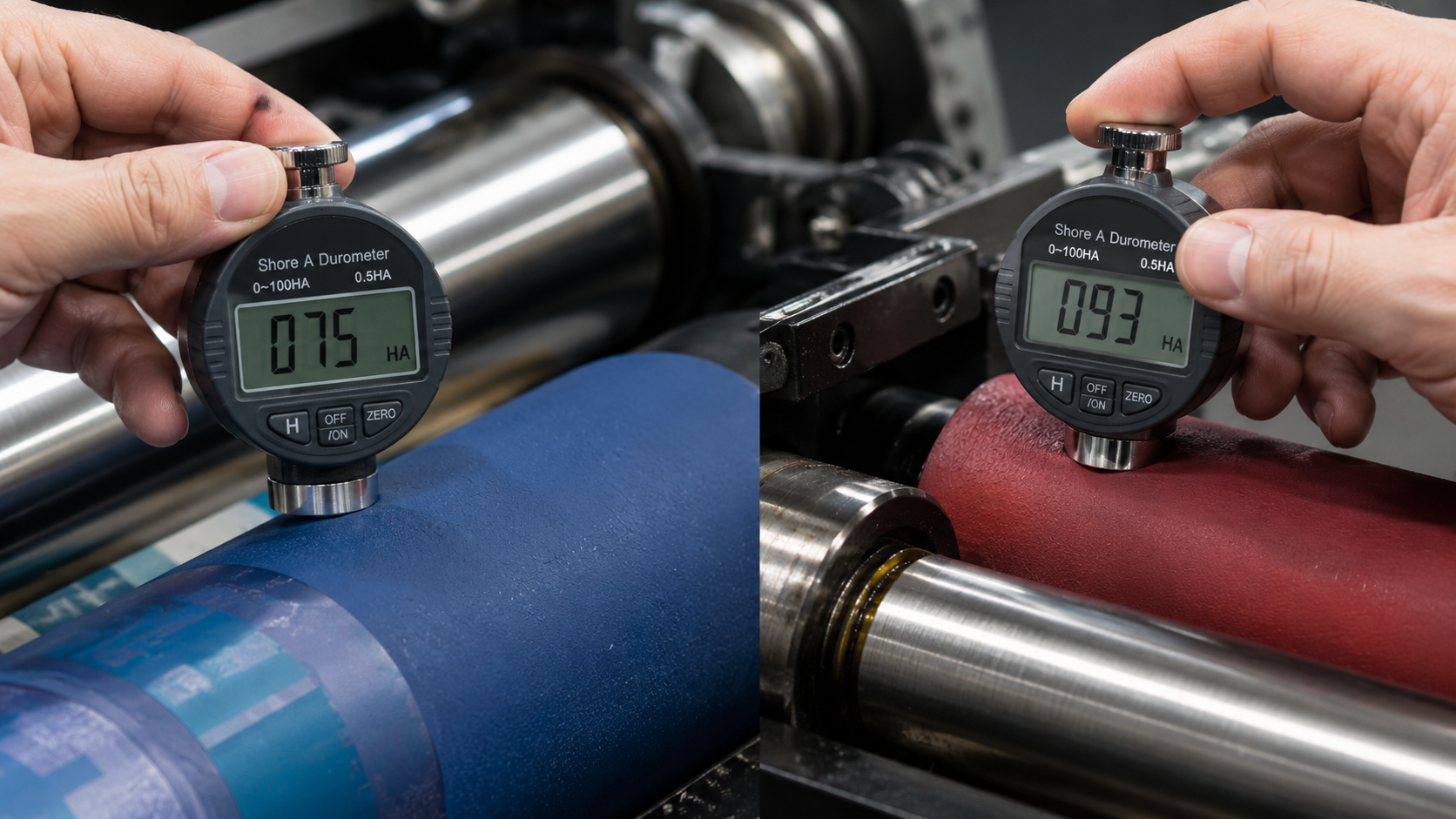
Work directly with a roller manufacturer (such as Böttcher or Westland) and match your current rollers to their vegetable oil compatibility matrices.
Confirm that your compounds match your input ink supplier’s datasheet.
Getting this written validation before you start production prevents a catastrophic $40,000 roller replacement disaster in the future.
Recalibrate Washup Systems
Changing ink chemistry without changing wash chemistry is an incomplete and unsuccessful transition.
Traditional solvent-based press washes are chemically incompatible with vegetable oil-based vehicles and remain a dominant source of volatile organic compound (VOC) emissions in your pressroom.
Switch your automated wash units to vegetable oil-based environmentally optimized wash media (EOM).
These are specifically formulated for bio-ink cleaning, reducing VOC production in the pressroom to near zero over the entire operating cycle.
This is where your Sreg savings materialize in the return on investment formula: disposal and insurance obligations for EOM wash solutions are just a fraction of the cost of legacy solvent-based alternatives.
Prepress Curve Linearization
Because biologically derived inks have a higher pigment density on a thinner film layer, your legacy ICC profiles, plate linearization curves, and TVI (Tone Value Increase) compensation tables need to be adjusted.
Before running your first live commercial job, dedicate some press time to running full calibration targets against your press characterization data.
Measure dot gain in 25%, 50%, and 75% tonal increments.
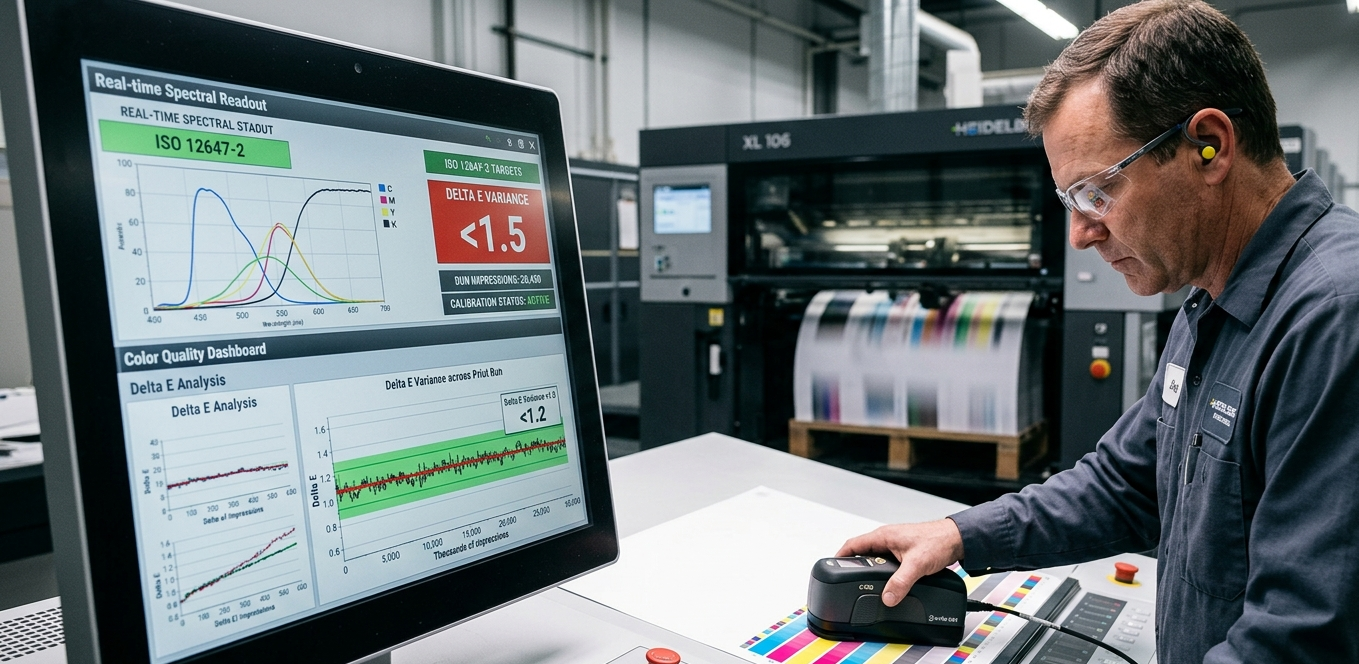
Generate updated, corrected plate curves for each printing unit and lock in your Delta E (ΔE) targets.
If done correctly, this step ensures that the transition is completely flawless for your customers, while instantly removing years of accumulated mechanical drift.

The Strategic Imperative
Let’s look at this without embellishment.
Holding onto legacy petroleum ink chemistry is an operational blind spot that simultaneously increases risk in three ways:
1. It introduces unallocated overhead into your facility’s cost metrics.
2. It increases your exposure as food safety laws and international deforestation laws tighten.
3. It automatically gives your competitors the edge in enterprise-level RFPs that require INGEDE deinkability data and EcoVadis Gold certification as prerequisites.
Industry leaders aren’t using advanced bio-inks because they want a green logo on their website.
They’re using them because they recognize that the enterprise contract market is completely changing the criteria for supplier qualification.
They’ve positioned themselves ahead of the curve.
These operations are now entering into multi-year preferred supplier agreements with the world’s most lucrative consumer brands and pharmaceutical clients.
The transition has an upfront cost.
The transition is a real number.
Re-engineering rollers takes time.
Changing washes requires training.
Re-calibrating prepress requires press capacity.
None of this is free, and pretending otherwise is the same kind of wishful thinking that bankrupted printers during the original transition to digital.
But when you apply a return on investment (ROI) formula with honest numbers at the plant level – including mileage reuse, waste reduction, regulatory relief and access to high-margin contracts – the math is completely undeniable.
Run the formula.
Schedule a roller audit.
Create a transition plan.
The window to exploit sustainability as a huge competitive advantage is closing fast – and the price of late adoption is paid in contracts you’ll never even have the chance to bid for.
Frequently Asked Questions (FAQ)
Why are bio-derived printing inks considered an ROI strategy rather than a compliance cost?
Bio-derived inks significantly lower the total cost of ownership. They eliminate hazardous waste removal fees, reduce VOC compliance overhead, and allow printers to achieve up to a 12% mileage increase per kilogram due to thinner, more efficient ink films.
What is the INGEDE Method 11 protocol in the printing industry?
INGEDE Method 11 is a standardized laboratory test used to evaluate the deinking ability and overall recyclability of printed paper. While legacy petroleum inks often fail this test, advanced bio-derived formulations consistently score 85 to 95+ points, satisfying strict corporate procurement RFPs.
How do sustainable bio-inks perform on porous and recycled papers?
Unlike low-viscosity mineral oils that aggressively bleed into paper fibers and cause excessive dot gain, bio-inks use higher molecular weight vegetable oils. This allows them to cure rapidly on the surface, holding dot geometry firmly and maintaining crisp contrast.
How do bio-derived inks help with Swiss Ordinance 817.023.21 compliance?
The Swiss Ordinance enforces strict thresholds for mineral oil aromatic and saturated hydrocarbons (MOAH/MOSH) in food packaging. Plant-based bio-inks completely eliminate this migration pathway at the molecular level, ensuring compliance without the need for expensive barrier coatings.