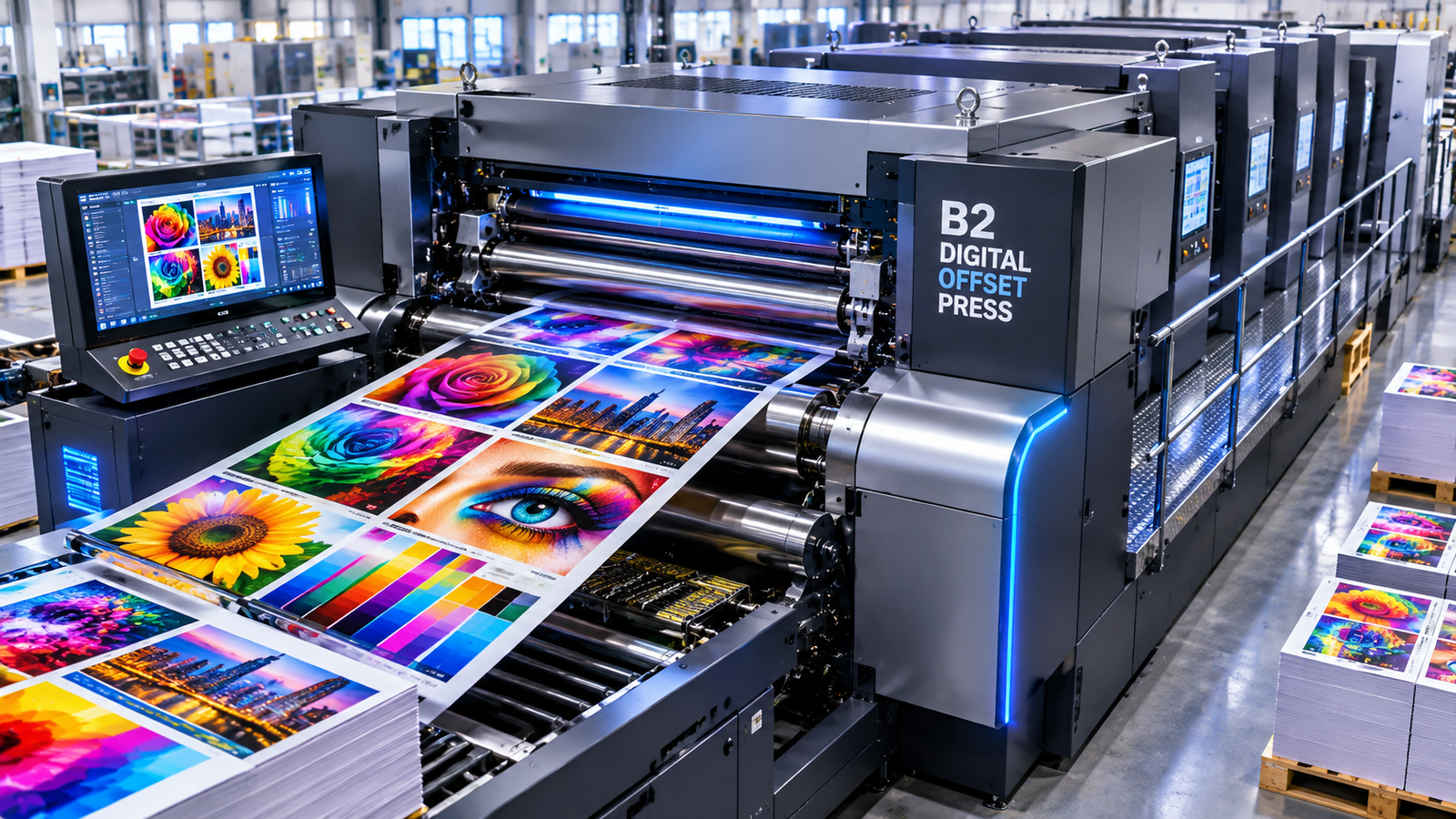
What is Digital Offset Printing?
Digital offset printing is a plateless digital printing process that uses liquid electrophotography (LEP).
HP ElectroInk, a liquid toner with pigment particles of roughly 1–2 microns, is imaged electrostatically onto a photoconductor, transferred to a heated offset blanket, and then pressed onto paper, film or board.
The technology behind that definition is the HP Indigo platform.
It began as Benny Landa’s research into liquid-toner copying in Israel in 1977 and now spans A3 sheetfed presses, B2 sheetfed presses rated up to 6,000 sheets per hour, and narrow-web label presses running at 120 metres per minute.
This article traces how liquid electrophotography moved from a plotter-duplicator concept to an industrial competitor of offset, and which engineering decisions made each step possible.
How Digital Offset Works
HP ElectroInk and Liquid Electrophotography (LEP)
ElectroInk is a suspension of pigmented thermoplastic resin particles in a non-conductive hydrocarbon carrier.
HP supplies it as a concentrated paste in sealed cartridges.
Inside the press it is diluted with imaging oil into the fluid that the imaging system actually uses.
The defining number is particle size.
ElectroInk particles go down to 1–2 µm, while powder toners typically run 5–10 µm.
Because resolution and edge definition in electrophotography scale with particle size, the liquid system resolves finer detail and smoother vignettes than dry toner can, which is the technical reason behind the quality advantage described in the original 2013 version of this article.
The concept predates Indigo.
Liquid electrophotography was invented in 1952 by Ken Metcalfe in Adelaide, Australia.
Landa has acknowledged that lineage himself, describing Indigo’s contribution as making the process work as a commercial technology.
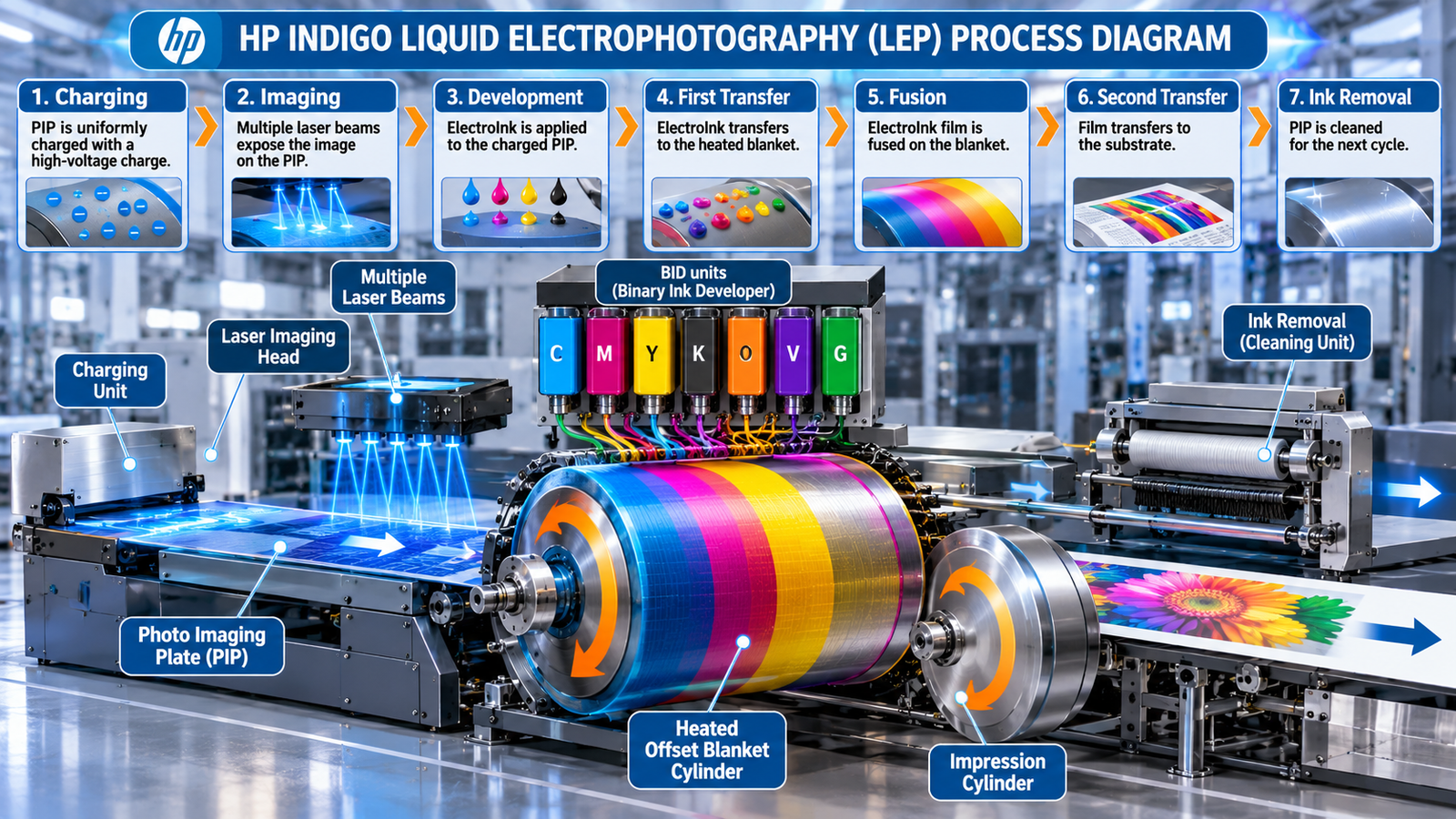
The imaging cycle
A conventional LEP press moves the image through five stages:
- Charging. A charge roller applies a uniform electrostatic charge to the rotating photo imaging plate (PIP).
- Imaging. A laser unit, using as many as 40 beams in parallel, exposes the PIP and writes a latent electrostatic image. Native writing resolution on standard presses is 812 dpi at 8 bit, with High Definition Imaging (HDI) addressability of 2,438 × 2,438 dpi. HD models write at 1,624 dpi (virtual 4,876 × 4,876 dpi).
- Development. A Binary Ink Developer (BID) presents one colour of charged ElectroInk to the plate, and particles adhere only to the imaged areas. A traditional LEP engine supports up to seven BIDs.
- Transfer to the blanket. The inked image transfers from the plate to a heated offset blanket. Heat causes the resin particles to coalesce into a cohesive film, the behaviour that gave early ElectroInk its description as a liquid ink that turns plastic when heated.
- Transfer to the substrate. The blanket presses the film onto the stock. The ink sits on the surface with little penetration, which is why Indigo output is routinely compared with litho for surface smoothness and sharpness.
The plate, blanket and impression cylinder arrangement mirrors a lithographic press, and Indigo marketed the result as Digital Offset Color.
One-Shot color
On Indigo presses, the separations can be built up on the blanket and transferred to the substrate in a single operation instead of color by color.
HP calls this One-Shot.
Because the full-color image is transferred in one impression, HP positions One-Shot as the basis for tight registration between separations without loss of print quality.
Later presses, including the 30000 and the LEPx-based V12 described below, use the same principle.
Enhanced Productivity Mode (EPM)
HP introduced Enhanced Productivity Mode first on label presses and extended it to sheetfed models in 2012.
EPM prints with cyan, magenta and yellow only, building black from the three process colors.
Three separations instead of four give a 33% throughput gain: on the B2 HP Indigo 10000, speed rises from 3,450 to 4,600 sheets per hour.
The trade-off is job suitability.
Fine black text needs tight registration when it is composed of three colors instead of one, so EPM is usually paired with preflight checks that decide which files can safely run in CMY.
LEP versus dry toner and inkjet
| Liquid electrophotography (HP Indigo) | Dry toner electrophotography | Inkjet | |
|---|---|---|---|
| Colorant | Pigmented resin particles in imaging oil | Powder of binder, charge-control agent and colorant | Pigment or dye in an aqueous, solvent or UV-curable vehicle |
| Particle size | 1–2 µm | Typically 5–10 µm | Not applicable; drops are fired from nozzles |
| Image formation | Electrostatic latent image, offset blanket transfer | Electrostatic latent image, fused with a high-temperature roller (above about 100 °C) | Drops placed directly by printheads, no electrostatic image |
| Behaviour on stock | Ink film sits on the surface | Fused polymer layer on the surface | Depends on absorption or curing; often relies on coatings or primers |
| Specialty and spot colours | Extra ink stations and off-press ink mixing | Varies by vendor | Varies by vendor and ink set |
Early Origins and Indigo NV (1977–1993: E-Print 1000)
Indigo was founded in 1977 in Rehovot, Israel, by Benny Landa, who had emigrated to Israel in 1974.
The founding goal was an improved copying process built on a liquid imaging medium instead of powder toner.
Early products were digital plotters and duplicators, and by the early 1980s the company had developed ElectroInk, the liquid ink whose resin particles fuse into a film under heat.
That property is what later made blanket transfer practical.
The product that took the process to market was the E-Print 1000, launched at IPEX in 1993.
It imaged directly from a computer file, removing plate-making from the workflow, and printed four colours (later up to six) on sheets.
Throughput was modest by later standards: about 1,000 four-colour A3 sheets per hour, or half that in duplex.
The same IPEX saw Xeikon and Agfa show the DCP-1 dry-toner web press, so both branches of digital colour production, liquid and dry toner, arrived at the same show.
Commercial traction followed.
Indigo had sold close to 300 E-Prints, priced around $400,000, by 1995, with Toyo Ink handling manufacture and sales for the Asian market.
The company stopped plotter production in 1995 to concentrate on presses, showed the Omnius press at drupa in 1995, and in 1998 announced the e-Print Pro (a lower-cost entry system) and the UltraStream, billed as the fastest digital printer of its day.
HP Acquisition and the B3 Series 2/3 Era (2002–2012: HP 5000 / 5500 / 7000 series)
HP takes control
HP agreed to acquire Indigo N.V. in September 2001 in a deal valued at up to $882 million in stock and cash.
It completed its exchange offer on 25 March 2002, by which point HP held more than 96% of Indigo’s shares.
HP presented Indigo as a third high-speed colour print technology alongside inkjet and LaserJet, and the deal brought HP’s global sales and service infrastructure to the platform.
Series 2: HP Indigo 5000 and 5500
The first press co-developed by HP and Indigo engineers was the HP Indigo press 5000, shown in early 2004 and shipping from the fourth quarter of that year.
It printed up to seven colors at about 68 four-color A4 pages per minute (roughly 4,000 pages per hour), with a reworked paper path for lighter stocks, multiple paper trays and inline finishing support.
HP’s own comparison put Series 2 at roughly double the hourly output of the first generation, from about 2,000 to 4,000 pages.
The HP Indigo press 5500, launched in May 2007, became the best-selling press in Indigo’s history, with more than 1,500 units built by March 2012.
The 5600 followed with EPM support, running at 68 pages per minute in four colours and 90 pages per minute in EPM.
Series 3: HP Indigo 7000 and the 13 × 19 inch workhorse
At Drupa 2008, HP announced the HP Indigo 7000, a B3-class (SRA3+, 13 × 19 inch) sheetfed press running at 120 four-color A4 pages per minute, more than 70% faster than its Series 2 predecessor.
Rated output was 7,200 sheets per hour in one or two colors and 3,600 sheets per hour in four colors.
Imaging was 812 or 1,219 dpi at 8 bit with 2,438 × 2,438 dpi HDI addressability and screens from 144 to 230 lpi.
Substrate latitude on the 7000 family covered coated stocks from 80 to 350 gsm and uncoated from 60 to 320 gsm, up to 400 µm thick.
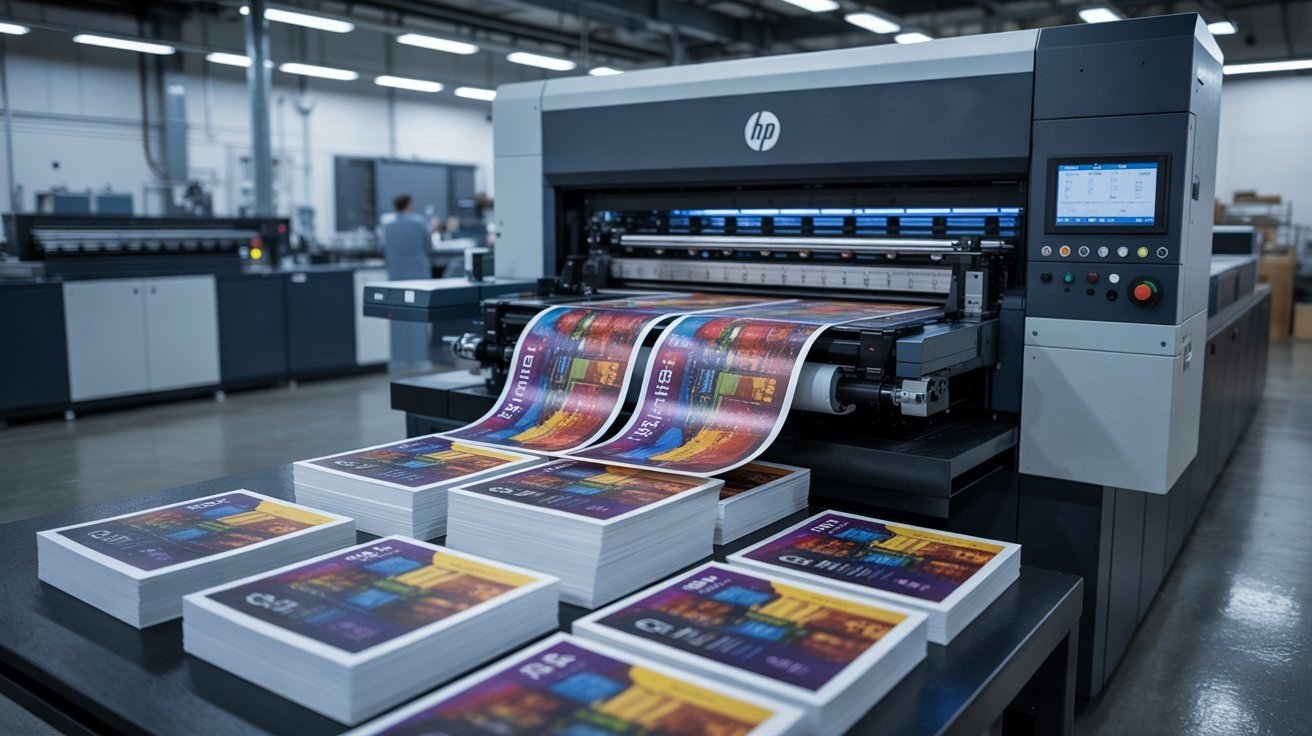
The 7000 was HP’s strongest launch to that point-130 installations in its first three months, including a 36-press order from Consolidated Graphics.
It also earned the first GRACoL proofing certification for a production press, plus Fogra validation.
HP calculated at launch that the break-even point against an A3 offset press for an eight-page brochure had risen to around 1,800 copies.
The line then developed in steps: the 7500 (IPEX 2010) added press automation, and the 7600 reached 160 pages per minute in EPM, a 33% gain over the 7500’s 120 pages per minute.
The 7800 and, at drupa 2016, the 7900 carried the platform forward.
All of them were built on the same LEP principles, with higher speed and more automation each generation.
The B2 Disruptive Era (2012–2019: HP Indigo 10000, 12000, 12000 HD, 20000, 30000)
Drupa 2012: Series 4 and the 29-inch format
At a pre-drupa event in Israel on 13 March 2012, HP unveiled the fourth generation of Indigo, and its first B2 press.
Indigo had shown a B2 prototype at drupa 2000 that never reappeared, so the 10000 was a new design rather than a revival.
The HP Indigo 10000 is a seven-color, 29-inch sheetfed press taking sheets up to 750 × 530 mm.
It prints 3,450 B2 sheets per hour in four colors, 1,725 per hour in four-color duplex, and 4,600 in EPM.
The B2 format matters because it fits the finishing lines that offset printers already own.
Commercial availability began in early 2013.
Series 4 also extended LEP beyond paper.
The web-fed HP Indigo 20000 takes a 762 mm web, with films from 10 µm, and HP positioned it against flexo with gravure-like quality claims.
The sheetfed HP Indigo 30000 accepts sheets up to 75 × 53 cm and boards up to 600 µm, with an inline primer for synthetic materials.
High-opacity Premium White ElectroInk arrived on the 20000 and the 7900 during this generation, giving packaging converters the opaque white that flexible packaging requires.
By the end of 2015, there were 230 installations of the 10000 worldwide.
Drupa 2016: HP Indigo 12000, HD imaging and the 50000
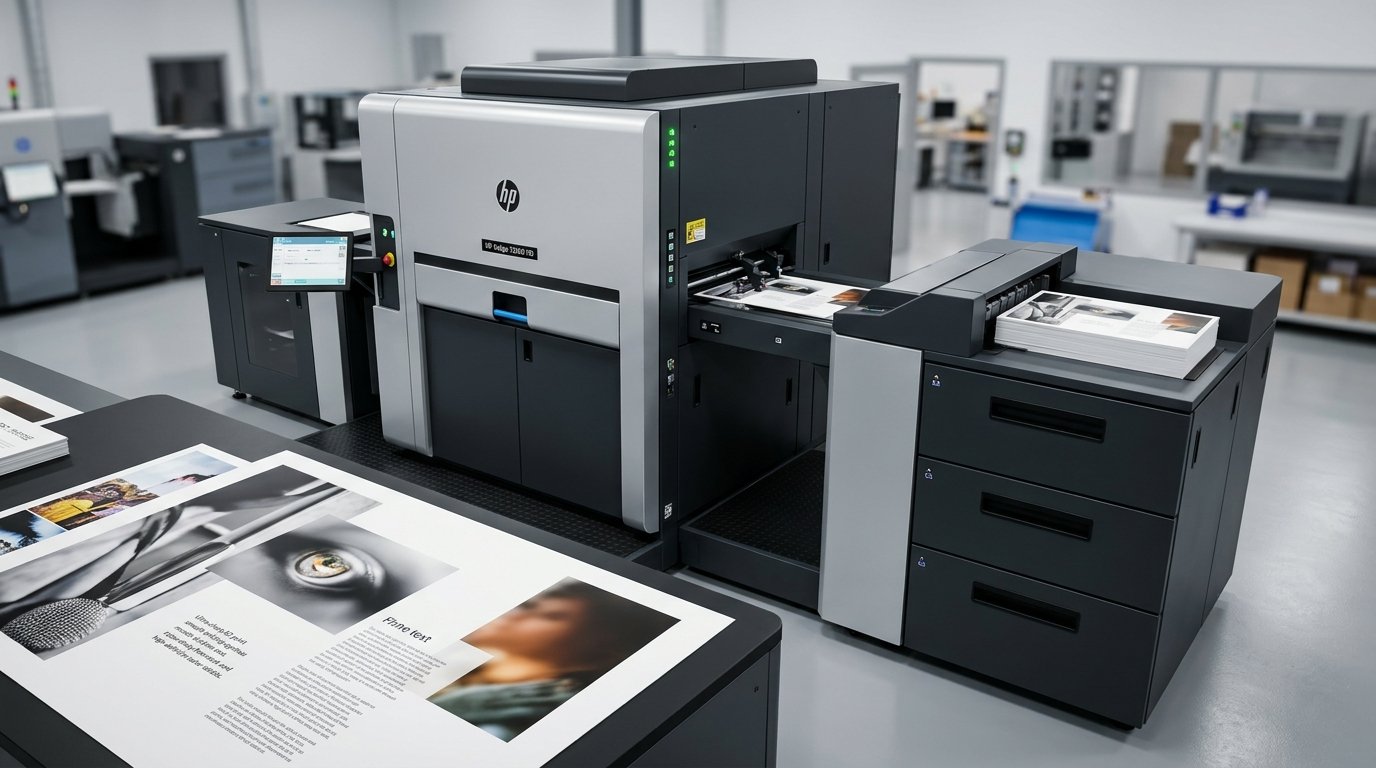
The HP Indigo 12000 used the 10000 platform with new hardware inside, printing up to 4,600 B2 color sheets per hour and more than two million sheets per month, with duplex monochrome at the same 4,600 sheets per hour.
Stock weights run from 70 to 400 gsm. HP launched it alongside the oversized B1 duplex HP Indigo 50000 and refreshed the A3 line with the 7900 and 5900.
The other change was resolution.
The HP Indigo 12000 HD carries a high-definition writing head that doubles imaging resolution from about 800 dpi to about 1,600 dpi (1,625 dpi in the 12000 HD specification), delivering finer detail at the same press speed.
HD configurations add finer screens (the current 120K HD lists 230 and 250 lpi) and HDFM, a frequency-modulated screening mode in which randomly placed, smaller dots increase sharpness on photographic work.
HP announced the 12000 HD in 2017,by September 2019, more than 100 had been sold, and HP counted over 750 B2 Indigos installed worldwide.
Industrial Scale and the LEPx Architecture Era (2020–2026: LEPx, V12, 100K, 200K, 15K, 6K/7K)
March 2020: Series 5 and Series 6
On 10 March 2020, ahead of a Drupa that the pandemic would push to 2024, HP revealed the LEPx architecture with the V12 label press (the first Series 6 press), the B2 100K (the first Series 5 press), and the 15K, 7K, 7eco, 6K and 25K.
LEPx: parallel imaging explained
Conventional LEP images separations one after another on a single engine, so speed falls as colors are added.
On the 6K series, one engine passes up to seven colors sequentially, reported at about 30 m/min in four colors.
LEPx replaces that sequence with six imaging engines working in parallel.
Each engine has an LED imaging array of more than 20,000 diodes writing onto a photo imaging drum (PID), which replaces the PIP, and two switchable Binary Ink Developers.
Six engines with two BIDs each give 12 on-press inks.
The engines deposit their separations simultaneously onto a transfer blanket belt about six metres long, and the registered image is transferred to the substrate in one shot.
The result is a single, known process speed for any job: 120 m/min (400 ft/min) on a 340 mm web, with LED imaging at 1,600 dpi.
The HP Indigo V12, the first LEPx press, was announced in March 2020 for commercial availability in 2022.
It supports film from 12 µm to board of 450 µm with an integrated inline primer.
Beta installations followed, and HP announced general commercial availability alongside its Drupa 2024 launches.
All4Labels, Eshuis and Nordvalls, three of its beta customers, each bought a second press, and by September 2025 HP was reporting customer runs above one million linear metres a month.
B2 sheetfed: 100K, 15K, 120K and 18K
The HP Indigo 100K, the first Series 5 press, is built for non-stop duplex work, rated at up to 6,000 sheets per hour and more than one million B2 duplex sheets per month.
HP delivered the 100th unit in March 2022, and in May 2023 the 1,000th B2 Indigo installed worldwide was itself a 100K.
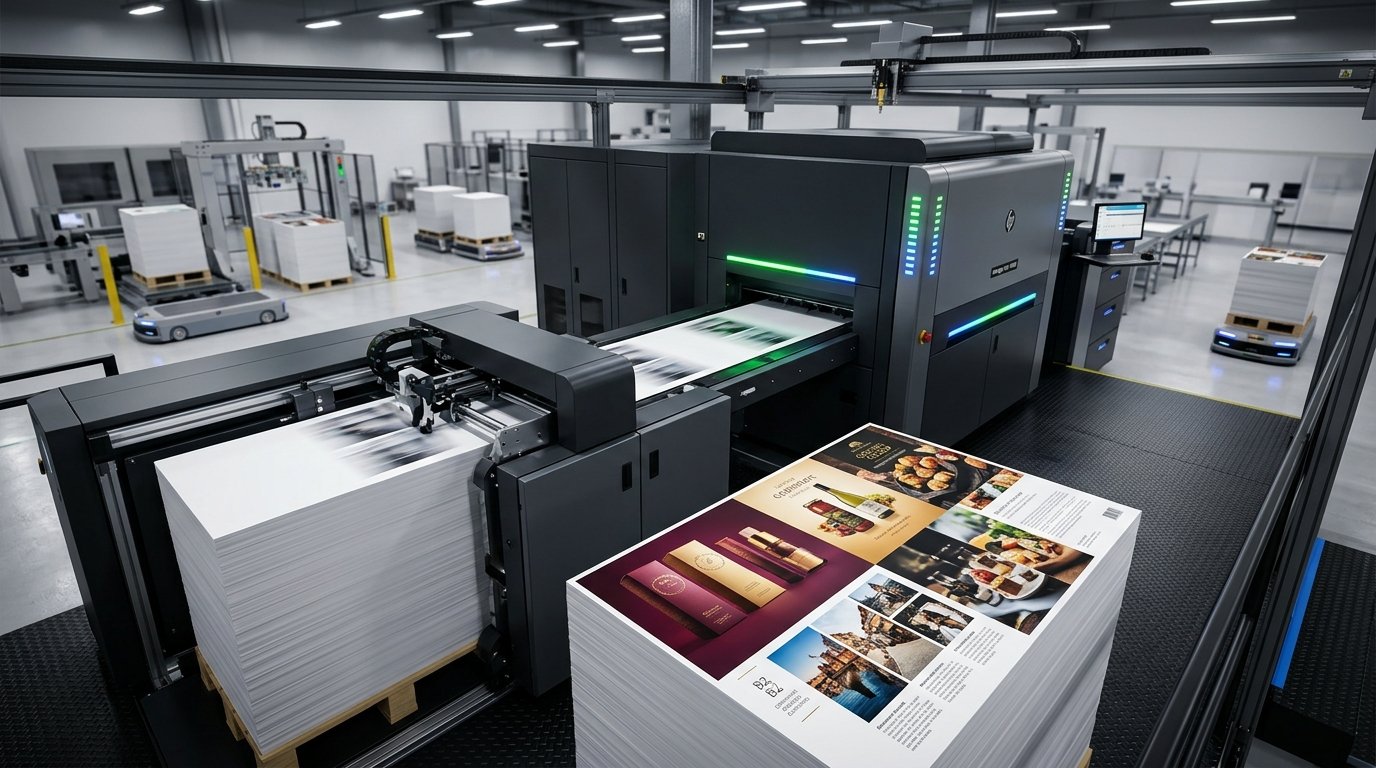
The HP Indigo 15K is the platform for broad applications-HD modes and FM screens, substrates up to 600 µm (24 pt), non-stop feeding from five input sources, predictive press care, and new Premium White and Invisible Yellow ElectroInks.
At Drupa 2024, HP introduced two new generations of B2 press.
The HP Indigo 120K runs at 6,000 sheets per hour in EPM and 4,500 in four colors, produces over two million B2 sheets per month, and is specified for up to 90% press availability.
It has a five-source dynamic feeder, AI-based inspection and error recovery, seven ink stations with 12 specialty ElectroInks, and an ECO mode that uses a thinner ink layer to cut carbon footprint by 11%, according to HP.
The HP Indigo 18K is the next generation of the 15K, rated at 4,600 sheets per hour in EPM, with seven color stations.
HP describes it as handling the widest range of applications of any single B2 digital press.
HP also announced the 7K Secure at the same event. In June 2026, HP launched the 18K Value Pack for existing 15K owners, adding a one-shot duplex thick-media kit for stocks up to 600 µm and a simplified interface.
A3/SRA3+: 7K, 7eco and 7K+
The HP Indigo 7K is a 19-inch SRA3+ press with media compatibility up to 550 µm and more than 20 specialty inks.
The 7eco is the entry-level variant, rated at 160 color pages per minute in EPM.
In March 2026, HP unveiled the HP Indigo 7K+ at Dscoop Edge Rockies, built on the 7X00 platform that has more than 2,200 presses installed, and announced worldwide availability at Dscoop Europe in June 2026.
Its new Eco Print Mode is a four-color mode with a thinner ink layer for lower running costs on text-heavy work.
Labels and flexible packaging: 6K, 6K+, 25K and 200K
The HP Indigo 6K, the new model of the 6000 series, shipped with ElectroInk Silver, Fluorescent Pink, a wider white portfolio and Spot Master colour automation.
In September 2025, HP introduced the 6K+ at Labelexpo Europe, adding a SmartControlSystem, AI-powered Automatic Alert Agent 2.0 and 97% colour-gamut coverage with specialty and white inks, and marked the installation of its 3,000th label and packaging press.
For flexible packaging, the 25K replaced the 20000 in 2020.
In March 2023, HP launched the HP Indigo 200K, a Series 5 press printing up to 56 m/min (183 ft/min), with up to 30% more speed and 45% more productivity than the 25K, on top of an installed base of more than 300 25K presses.
Specialty ElectroInks as the Offset-Rivalry Engine
Offset printers differentiate on spot colors, metallics, whites and security inks.
LEP’s answer is a modular ink system- HP Indigo sheetfed presses carry up to seven ink stations (the V12 carries 12) that can be loaded with CMYK, extended-gamut inks or specialty ElectroInks. The 120K lists 12 specialty ElectroInks, and the 7K family more than 20.
| ElectroInk | What it does | Offset-side equivalent |
|---|---|---|
| IndiChrome sets (orange, violet, green) | Extends gamut to six or seven colours; the off-press IndiChrome Ink Mixing Service reproduces up to 97% of the PANTONE range | Pantone spot inks and ink-room matching |
| Premium White | High-opacity white that reduces the number of passes on dark, kraft and clear stocks | Opaque white passes, screen or flexo white |
| Silver | Metallic effects across the colour gamut (silver, gold and other metallics) | Metallic offset inks and foil |
| Fluorescent Pink (plus Vivid Pink and Vivid Green on the 18K) | High-impact luminous colours | Fluorescent spot inks |
| Invisible Yellow and Blue (earlier Invisible Red) | Visible only under UV; supports static and serialised security codes | UV security inks |
| Light Cyan, Light Magenta, Light Black | Smoother highlights and deeper colour on photo work | Extra photo separations |
| OVG CMYK and fade-resistant inks | Lightfastness for outdoor use | Outdoor-rated ink sets |
The 2020–2026 HP Indigo Portfolio by Segment
| Segment | Format | Presses |
|---|---|---|
| Commercial, A3/SRA3+ | 13 × 19 in sheets | 7K, 7K+, 7eco |
| Commercial, B2 | 29 in sheets (750 × 530 mm) | 15K, 18K, 100K, 120K (HD options) |
| Photo and specialty | B1, roll-fed simplex | 90K |
| Labels, narrow web | 340 mm web | 6K, 6K+, V12 |
| Flexible packaging, mid-web | Roll-fed | 25K, 200K |
| Folding carton | Sheetfed, boards to 600 µm (24 pt) | 35K (derived from the 30000), 15K/18K |
| Secure printing | Sheetfed and web | 6K Secure, 7K Secure |
Technical Timeline
| Year | Milestone |
|---|---|
| 1952 | Ken Metcalfe invents liquid electrophotography in Adelaide |
| 1977 | Benny Landa founds Indigo in Rehovot, Israel |
| Early 1980s | ElectroInk liquid ink developed |
| 1993 | E-Print 1000 launched at IPEX |
| 1995 | Omnius shown at drupa; plotter production ends |
| 2001–2002 | HP agrees (September 2001) and completes (25 March 2002) the Indigo acquisition |
| 2004 | HP Indigo press 5000, the first HP/Indigo co-developed press |
| 2007 | HP Indigo press 5500 launched |
| 2008 | HP Indigo 7000 announced at drupa |
| 2012 | EPM brought to sheetfed; HP Indigo 10000, 20000, 30000 unveiled (B2) |
| 2016 | 12000, 50000, 7900, 5900 launched at drupa |
| 2017 | 12000 HD announced (about 1,625 dpi imaging) |
| 2020 | LEPx, V12, 100K, 15K, 7K, 7eco, 6K and 25K announced (10 March) |
| 2023 | 200K launched (21 March); 1,000th B2 Indigo installed (May) |
| 2024 | 120K and 18K introduced at drupa; V12 general availability |
| 2025 | 6K+ debuts at Labelexpo Europe; 3,000th label and packaging press |
| 2026 | 7K+ unveiled (March) and released worldwide (June); 18K Value Pack |
Frequently Asked Questions
What is Digital Offset Printing?
Digital offset printing is a plateless digital printing process that uses liquid electrophotography (LEP): HP ElectroInk, a liquid toner with pigment particles of roughly 1–2 microns, is imaged electrostatically onto a photoconductor, transferred to a heated offset blanket, and then pressed onto paper, film or board.
How does HP ElectroInk differ from dry toner?
HP ElectroInk features extremely small particle sizes (1–2 µm compared to 5–10 µm in dry toners). Suspended in a liquid carrier, ElectroInk turns into a cohesive plastic film on a heated blanket, enabling offset-quality edge definition, surface smoothness, and high substrate latitude without thick toner build-up.
What is HP Indigo LEPx technology?
LEPx is a parallel imaging architecture introduced by HP Indigo that uses six imaging engines working simultaneously instead of a single sequential engine. This enables process speeds up to 120 meters per minute regardless of the number of colors printed.