
The regulatory calendar for 2026 leaves absolutely no room for improvisation.
While the industry is still recovering from fluctuations in the supply chain, we have two dates ahead of us that will permanently change the way we purchase materials, design packaging, and manage production:
May 31, 2026 — The first critical deadline for data submission under the Extended Producer Responsibility (EPR) law has been completed in key U.S. states.
August 12,2026 — A new EU Regulation on Packaging and Packaging Waste (PPWR) comes into effect in all 27 member states.
For production directors (COO), packaging engineers, and corporate print buyers, this is no longer a topic for the ecology department.
This is a direct blow to profit margins and operational stability.
Here is a clear, technical, and operational overview of what is changing and how your printing company must respond.
EU PPWR (Packaging Regulation) – Key Dates and Requirements
Regulation, not directive: The end of the fragmented market
The key structural difference compared to the old Directive (94/62/EC) is often underestimated.
PPWR (EU Regulation 2025/40) is not a directive.
This means that there is no “adaptation phase” or translation into the local laws of the member states.
The regulation is directly applicable throughout the European Union in the same form.
What does that mean for you in practice?
If you serve multiple EU markets, you no longer have to juggle 27 different national recycling rules.
However, there is no “grace” period.
Packaging produced and placed on the market on or after August 12 2026 must be 100% compliant.
Although the reuse targets will only be activated in 2028 and 2029 restrictions on hazardous chemicals and the labeling system are applied immediately.
Strict ban on PFAS in food packaging
This is a red alert for all facilities that print packaging for fast food.
• 25 ppb (µg/kg) for any individual PFAS
• 250 ppb for the sum of all detected PFAS substances.
• 50 ppm (mg/kg) for total PFAS, including polymeric versions.
Restriction of heavy metals (For ALL packaging)
Unlike PFAS related to food, restrictions on heavy metals affect absolutely every box, label, or wrapper that comes out of your printer.
The total concentration of lead, cadmium, mercury, and hexavalent chromium in packaging must not exceed 100 mg/kg.
This requires rigorous oversight of the pigments, UV inks, and protective varnishes that you purchase from your chemical suppliers.
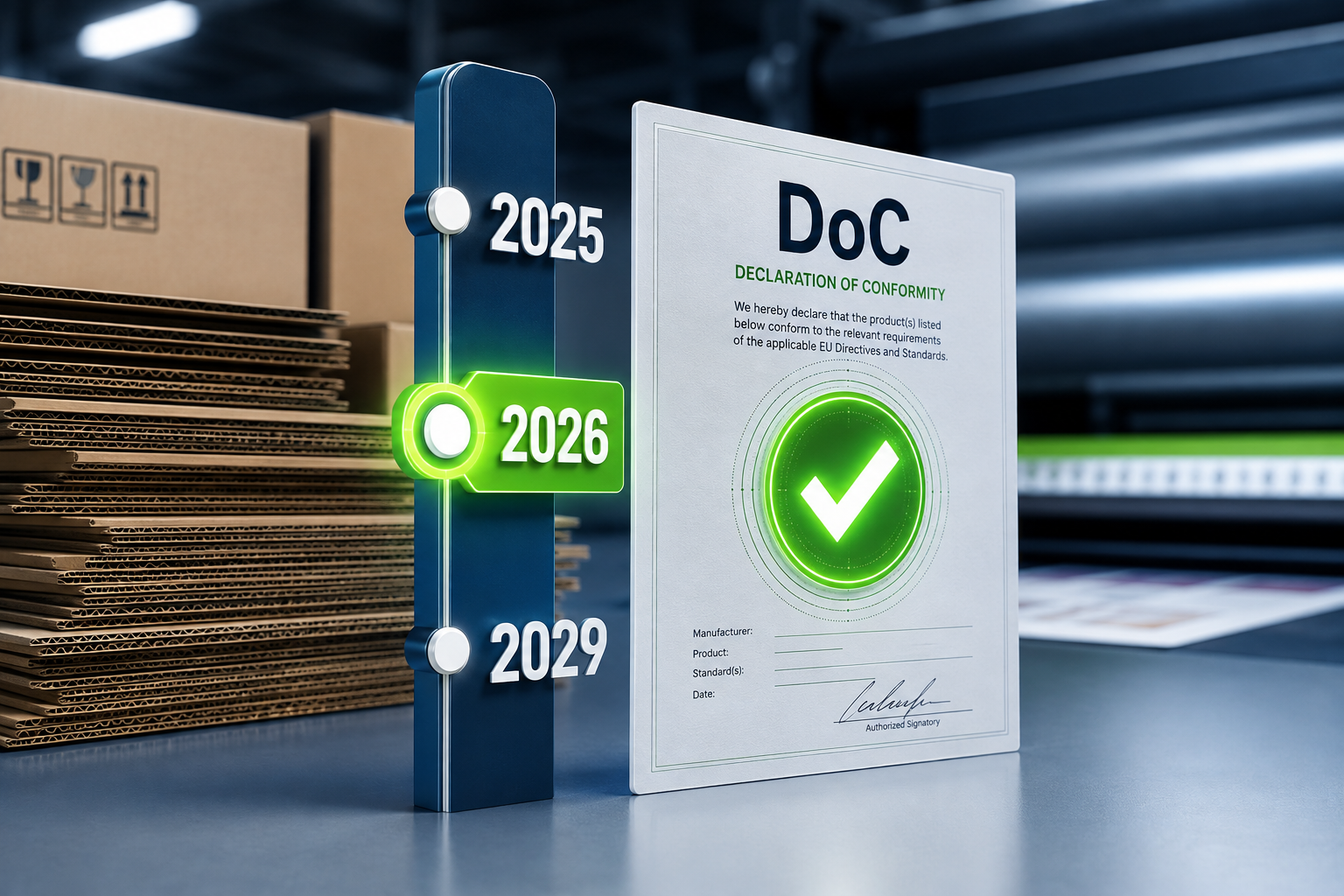
Declaration of Conformity (DoC) – Your new administration nightmare
From August 2026, every packaging must have an EU Declaration of Conformity.
The technical documentation that proves compliance must be kept for 5 years for single-use packaging and 10 years for reusable packaging.
Caution for printers: Big brands (your clients) will try to shift the legal responsibility for keeping this documentation onto you through procurement contracts.
Read the fine print carefully.
American EPR laws and plastic bans (2026)
In the United States, seven states (California, Colorado, Oregon, Maine, Minnesota, Maryland, and Washington) have activated extended producer responsibility (EPR) laws.
For most of them, the Circular Action Alliance (CAA) manages the reporting portals.
Deadline May 31 2026: The First Wave of Reporting
The end of May marked the first deadline for submitting data.
California, Colorado, and Oregon require extremely detailed reports — weight, type of material, and recyclability status for each individual SKU.
This data will serve as the basis for calculating the financial penalties (fees) that producers will have to pay starting from 2027.
California: The Loss of the Recycling Symbol (SB 343)
The SB 343 law (known as “Truth in Recycling”) brings enormous problems for prepress preparation.
From October 4, 2026, the classic symbol “chasing arrows” may not be printed on packaging unless the material meets strict criteria.
1.The material is collected in programs that cover at least 60% of California’s population.
2. It is processed in facilities that cover at least 60% of those programs.
What does that mean for your Prepress Department?
The rule is tied to the production date, not the sale date.
This means that your operators in preparation must locate, modify, and reapprove thousands of graphic files and create new plates/templates to physically remove this mark from the design before Q3 2026.
That’s a huge cost in labor hours.
Strategic Transition to Fiber-Based Packaging
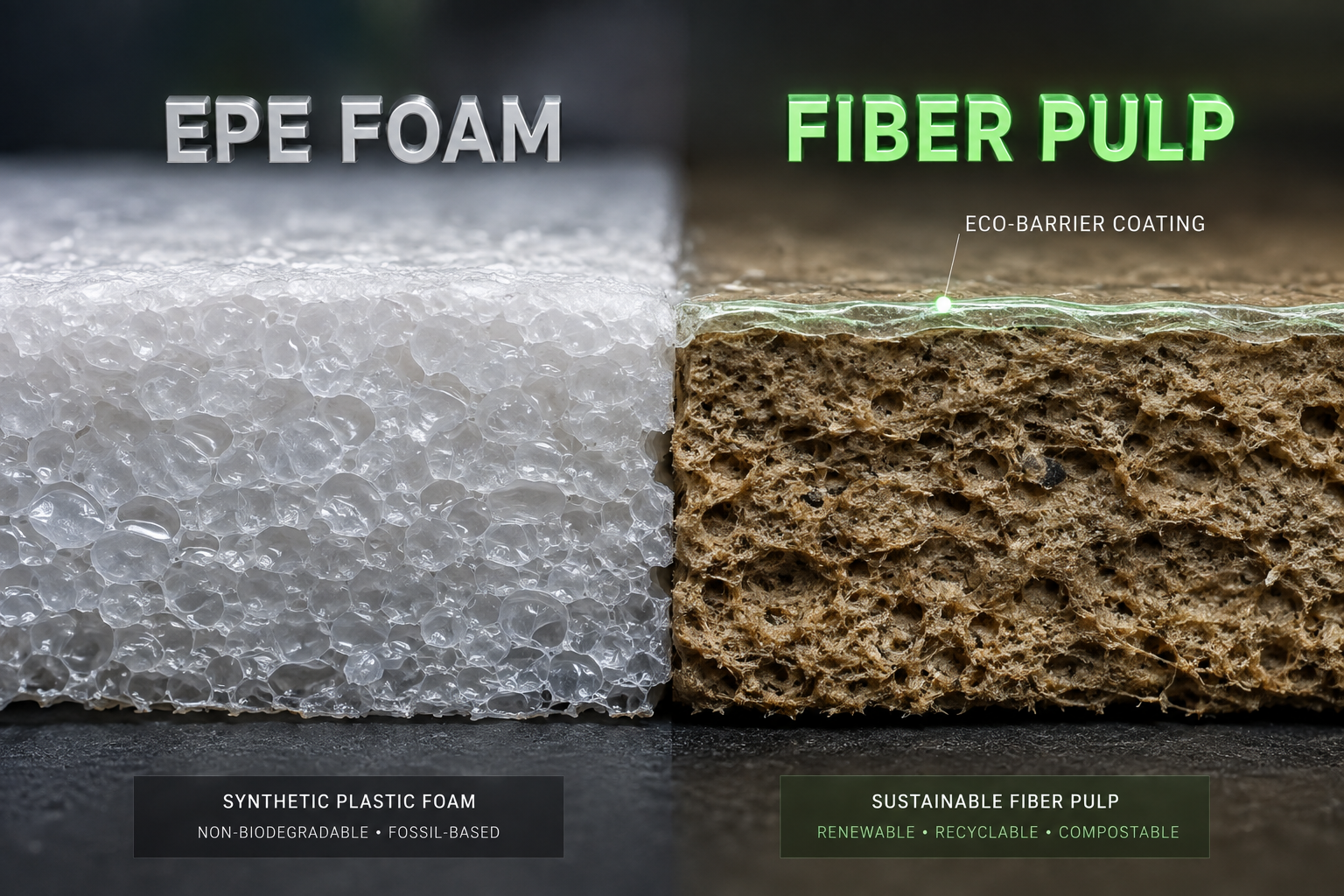
The combination of chemical bans and high EPR fees for plastic is driving the industry to make a massive shift from EPE foam (expanded polyethylene) to molded paper pulp and fiber alternatives.
This drastically changes the mechanics of production.
1. Die-Cutting Operations: Fiber materials, such as molded pulp, react completely differently to the pressure of the knives compared to plastic.
They produce more dust and require different blade angles.
Pulp requires crush or rule dies to break the fibres.
In addition, Pulp requires a large amount of tonnage to compress the thick walls.
Finally, pulp varies in thickness. Expect costs for machine recalibration and more frequent tool replacement.
2. Low-Migration Ink: With the transition to porous paper substrates, the risk of color migration to food dramatically increases.
Printing companies must switch to certified low-migration inks that do not introduce prohibited heavy metals into the equation.
Digitalization of Packaging: The Myth of the Universal DPP and the Introduction of QR Codes
In addition to chemical restrictions, the industry is currently shaken by another major regulatory confusion: the Digital Product Passport (DPP).
It is important to clarify the key difference between the overarching regulation on ecodesign (ESPR) and specific regulation on packaging (PPWR) right away.
PPWR and DPP are not the same thing, and PPWR does not require a universal Digital passport for every cardboard box.
While the DPP is a comprehensive “digital container” of product data, the PPWR introduces specific requirements for the use of digital data carriers (most often QR codes) on the packaging itself.
For your Prepress departments and the IT infrastructure of the printing house, the launch of the central EU DPP Registry on July 20, 2026. July 2026. marked the beginning of a new era in which static packaging design becomes a thing of the past.
Here is the operational calendar for digital print preparation:
February 12, 2027 (EPR digital identification): Packaging included in the extended producer responsibility (EPR) system can be identified by the appropriate symbol within the QR code (or other open technology).
This proves that the manufacturer pays their fees.
August 12,2028 (Harmonized labeling): Mandatory deadline for the new visual labeling system that explains to the end user the material composition and which bin the packaging should be disposed of in.
February 12, 2029 (Reusable packaging): All reusable packaging must have a dynamic QR code that tracks “rotations” (washing and refilling cycles,) and collection locations.
What does that Mean for Printing Operations?
For the printing industry and packaging manufacturers, this means a clear signal for adaptation.
Printers must prepare technologies for printing durable, machine-readable data carriers such as QR codes and RFID tags that lead to unique product identifiers.
The introduction of QR codes for traceability and EPR compliance means an accelerated integration of VDP (Variable Data Printing).
Your preparation software must be capable of generating and verifying the readability of dynamic QR codes at full printing speed, without compromising the OEE (Overall Equipment Effectiveness) metric of the machine.
The first step of your printing house is the so-called “Data Gap Analysis” in the supply chain — before you even start generating QR codes, you need to know whether you have received accurate information about recyclability from your suppliers.
The printing of standardized codes (QR code, Data Matrix) is mandatory, and they must be of high quality and durable.
Codes on packaging or labels must endure the entire lifespan of the product and remain legible for consumers and regulatory authorities.
Printing suppliers must ensure the accuracy of variable printing because each piece of packaging carries a unique identifier linked to the registry.
Conclusion and next Operational Steps
Attempting to resolve this compliance “on the fly” after the deadlines in August and October pass will result in blocked shipments at customs, contracts seized by major brands, and direct monetary fines.
Here are 3 steps that your printing house must take tomorrow morning:
1. Supply chain review down to the chemical level: Request written declarations from all suppliers of inks, varnishes, and adhesives regarding the content of PFAS and heavy metals according to the thresholds outlined in Article 5.
2. Prepress archive cleanup (SB 343): Instruct the preparation department to create a list of all active packaging designs that contain the “circle of arrows” symbol and are sold in the U.S. Start the process of removing the mark.
3. Updating commercial contracts: Legally define with your clients who owns the Declaration of Conformity (DoC) and who bears the costs of archiving technical documentation for the statutory period of 10 years.
Note: This article provides a technical overview based on public regulatory texts available in mid-2026 and does not constitute formal legal advice. Certain laws (especially SB 343) are subject to ongoing litigation. For a final assessment, consult a specialized legal advisor.
Frequently Asked Questions (FAQ)
What is the EU PPWR and when does it take effect?
The EU PPWR (Packaging and Packaging Waste Regulation) is a mandatory regulation directly applicable to all 27 member states, taking effect on August 12, 2026. It introduces strict rules on PFAS, heavy metals, and mandatory Declarations of Conformity.
What is the deadline for US EPR packaging reporting?
The first critical deadline for submitting packaging data under Extended Producer Responsibility (EPR) in key US states was May 31, 2026. The reported data serves as the basis for financial fees starting in 2027.
Does the PPWR require a Digital Product Passport (DPP) for all packaging?
No. PPWR and DPP are different. While the overarching ESPR introduces the Digital Product Passport, the PPWR specifically requires digital data carriers (like dynamic QR codes) for traceability, EPR compliance, and reusable packaging rotations.