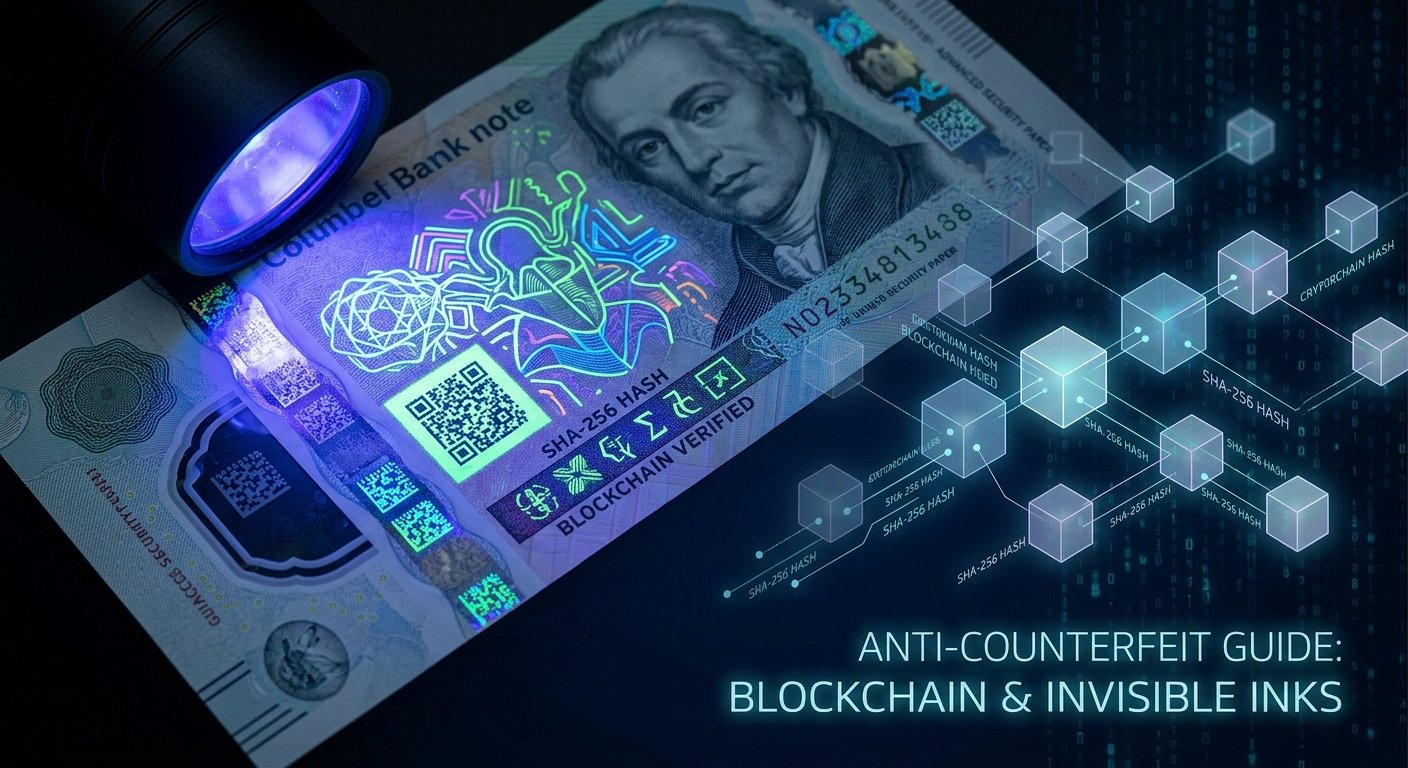
Anti-counterfeit printing combines covert inks that respond to ultraviolet (UV) or infrared (IR) light with serialized codes recorded on a blockchain ledger.
The ink binds authentication to the physical item, while the ledger stores one 256-bit cryptographic hash per serial that exposes altered records.
The ledger alone cannot confirm that a pack is genuine.
What Is Anti-Counterfeit Printing Technology?
Anti-counterfeit printing technology is the set of printed authentication elements whose detection depends on a defined wavelength, chemistry, or serialized code.
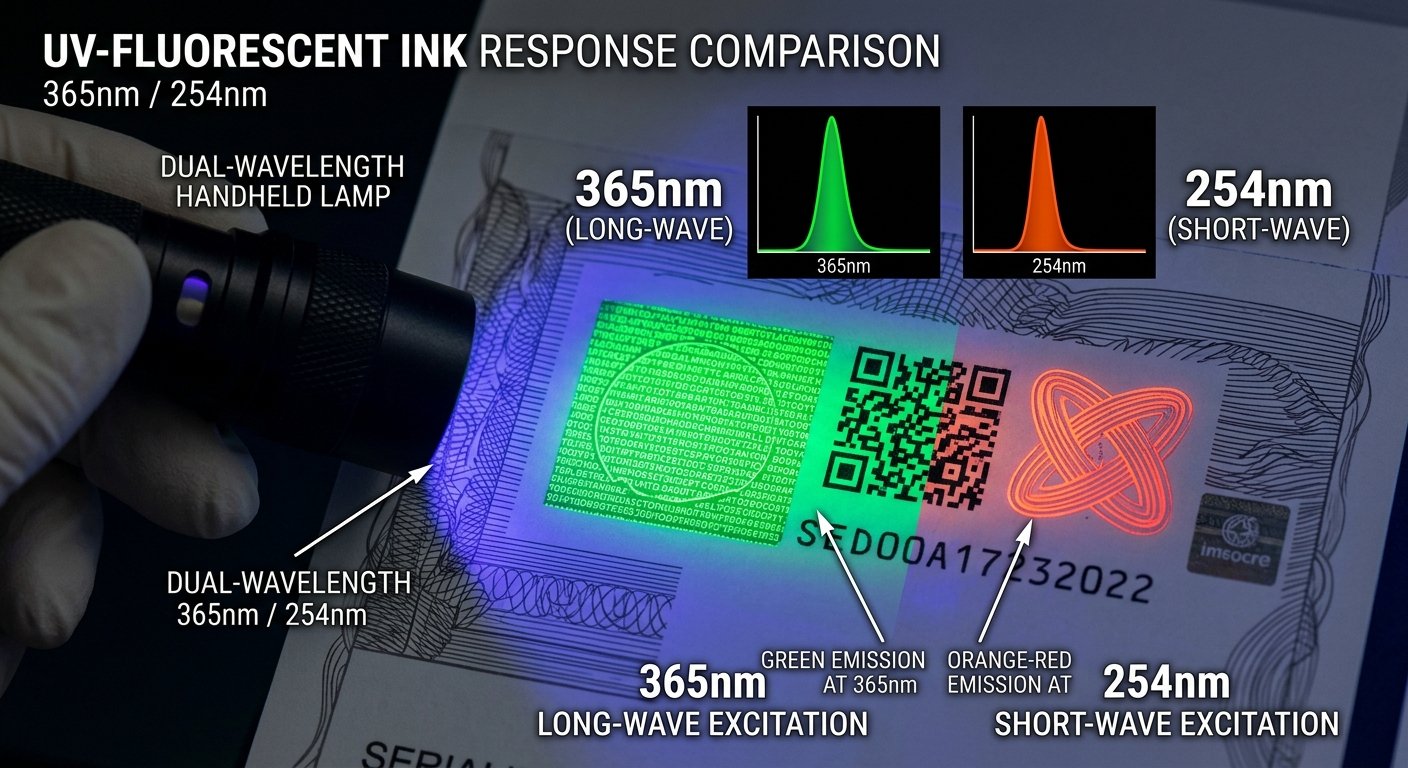
Covert elements include UV-fluorescent inks excited at 365 nm or 254 nm and IR-absorbing inks absorbing between 700 and 1,100 nm.
Molecular taggants add a forensic layer verified by instrument.
Cryptographic hash mapping links each printed serial to one 256-bit ledger digest, so any altered record produces a different digest.
UV-fluorescent ink, IR-absorbing ink, and molecular taggants supply the physical layer that a ledger cannot hold.
Pharmaceutical packaging, luxury packaging, and tax stamps apply the combination because each unit needs a unique, verifiable identity.
How Does Blockchain Serialization Work With Invisible Inks?
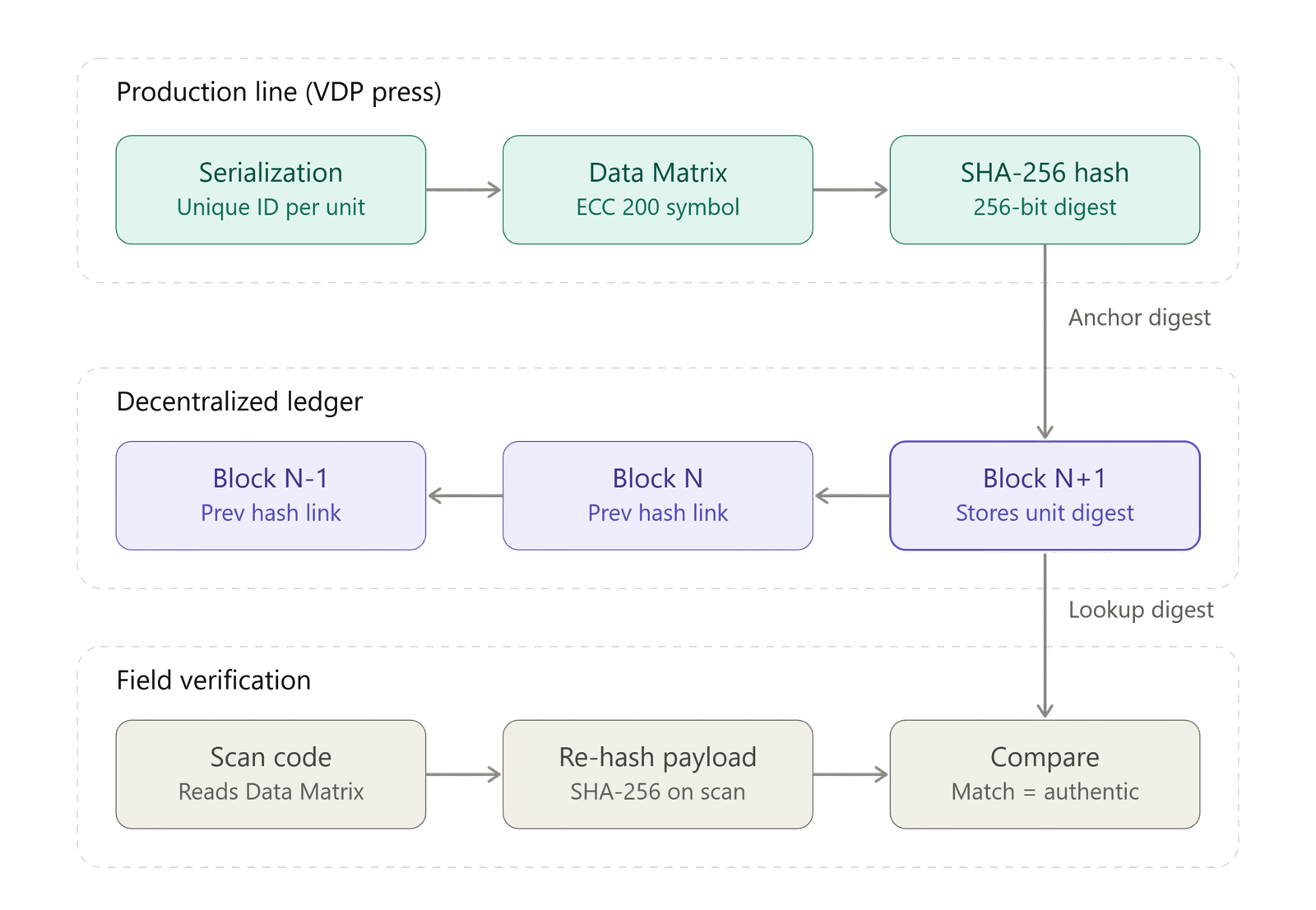
Blockchain serialization assigns each pack a unique serial, hashes the serial record with Secure Hash Algorithm 256 (SHA-256), and writes the digest to a distributed ledger.
Invisible ink adds a physical check at verification.
A scan confirms the code against the ledger, and a 365 nm lamp confirms the covert layer.
- Generate one unique serial per unit and pair it with the Global Trade Item Number (GTIN) and batch code.
- Compute the SHA-256 digest of each serial record; the output is 256 bits, written as 64 hexadecimal characters.
- Write the digest, not the raw record, to the ledger; confirm one ledger entry per serial.
- Print each serial as a two-dimensional (2D) Data Matrix code using variable data printing (VDP); reject codes below the specified grade.
- Print the covert ink layer at the film thickness stated in the technical data sheet (TDS).
- Verify the covert response inline with 365 nm UV illumination or an IR camera; reject sheets below the master-sample response.
- Reconcile printed serials against ledger entries per batch; quarantine the batch on any duplicate or missing serial.
- Scan the code, recompute the digest, and match it to the ledger entry; reject the item on any mismatch.
- Check the covert ink with a 365 nm lamp or IR reader; reject the item if the response is absent.
What Are the Specification Parameters of Anti-Counterfeit Inks?
Covert security inks are specified by excitation wavelength, emission response, ink film thickness, cure state, and substrate fluorescence.
UV-fluorescent grades use 365 nm or 254 nm excitation, and IR-absorbing grades use the 700 to 1,100 nm band.
Sheetfed offset transfers a process-ink film of 1 to 2 µm.
| Parameter | Value or Range | Unit | Test Method or Instrument | Note |
| UV excitation, long-wave | 365 | nm | Handheld UV lamp; spectrofluorometer | Typical; varies by formulation |
| UV excitation, short-wave | 254 | nm | Handheld UV lamp | Dual-response inks only; eye and skin protection required |
| IR absorption band | 700–1,100 | nm | IR camera; spectrophotometer | Typical; varies by formulation |
| Ultraviolet-light-emitting diode (UV-LED) curing peak | 365–405 | nm | Radiometer | Common peaks: 365, 385, 395, 405 nm; fluorescent pigments absorb curing UV |
| Sheetfed offset ink film | 1–2 | µm | Ink film thickness gauge; micrometer | Process-ink film; covert-ink film varies by formulation |
| Film substrate surface energy | 38–42 | mN/m (dyne/cm) | Dyne test pens; contact angle goniometer | Typical for film substrates; verify against TDS |
| Hash digest length | 256 | bit | SHA-256 specification | Equals 64 hexadecimal characters |
UV-Fluorescent vs IR-Absorbing Ink vs Taggant: Comparison
UV-fluorescent inks suit field checks with a 365 nm lamp, IR-absorbing inks suit machine reading between 700 and 1,100 nm, and molecular taggants suit forensic confirmation by instrument.
Selection follows the threat level, the verifier’s equipment, and the print process, not the ink’s visibility alone.
| Attribute | UV-Fluorescent Ink | IR-Absorbing Ink | Molecular Taggant | Selection Criterion |
| Security level | Covert (second line) | Covert (second line) | Forensic (third line) | Match level to counterfeit threat |
| Verification tool | Handheld UV lamp | IR camera or reader | Instrument reader or laboratory test | Match tool to the verifier |
| Stimulus (nm) | 365 or 254 | 700–1,100 | Varies by taggant chemistry | Confirm reader compatibility |
| Daylight appearance | Colorless; varies by formulation | Colorless to dark; varies by formulation | Follows the host ink or varnish | Check against brand design |
| Print processes | Offset, flexographic, screen, gravure, inkjet | Varies by formulation | Mixed into the host ink or varnish | Confirm against TDS |
| Relative copy resistance | Lower | Moderate | Higher | Combine layers as threat rises |
| Primary limitation | Optical brightening agent (OBA) fluorescence in paper masks the signal | Carbon black masks the signal | Requires reader or laboratory access | Test substrate and overprints before release |
Why Do Anti-Counterfeit Printing Features Fail in Production?
Anti-counterfeit printing features fail in production through five root causes: UV-absorbing overcfuvoats that block 365 nm excitation, optical brightening agent fluorescence in paper, carbon black that masks the IR signal, pigment absorption that inhibits UV cure, and variable data printing errors that duplicate serials.
Checks run from cheapest, lamp inspection, to most invasive, laboratory spectroscopy.
| Symptom | Probable Root Cause | Diagnostic Check | Corrective Action | Acceptance Criterion |
| Weak or absent fluorescence at 365 nm | UV-absorbing overcoat or low covert-ink film | Compare with master sample under 365 nm lamp; measure film thickness | Remove the overcoat; raise film within press tolerance | Response matches master sample within brand-owner tolerance |
| Background fluorescence from unprinted stock | OBA content in paper or board | Inspect unprinted stock under 365 nm lamp | Specify stock without OBA | No fluorescence above reader threshold |
| IR feature not distinguishable | Carbon black in adjacent or underlying ink absorbs across the IR band | Image sample with IR camera at 700–1,100 nm; list overprint inks | Print IR ink on a non-black ground; knock out black beneath | IR contrast meets reader threshold set by specification |
| Smearing or failed solvent rub on covert layer | Fluorescent pigment absorbs curing UV and limits light reaching the photoinitiator | Methyl ethyl ketone (MEK) double rub; radiometer energy dose in mJ/cm² | Raise dose to the TDS value; match lamp output to photoinitiator absorption | Passes MEK double-rub count stated in TDS |
| Duplicate serials or ledger mismatch | Variable data printing file error or reprint without ledger update | Reconcile printed serial log against ledger entries per batch | Quarantine the batch; void duplicates; reissue serials and ledger entries | 100 % one-to-one match; zero duplicates |
How Is Anti-Counterfeit Performance Measured and Standardized?
ISO 12931, issued by the International Organization for Standardization (ISO), sets performance criteria for authentication solutions used against counterfeiting of material goods without prescribing a technology.
Measured parameters include fluorescence response at 365 nm, cross-cut adhesion class 0 to 5, solvent resistance in MEK double rubs, and 100 % serial-to-ledger reconciliation.
| Parameter | Value or Range | Unit | Test Method or Instrument | Note |
| Fluorescence response | Match to approved master sample | Relative intensity | 365 nm lamp; spectrofluorometer | Tolerance set by brand owner |
| Cross-cut adhesion | 0–5 | ISO 2409 class | Cross-cut cutter; adhesive tape | ASTM D3359 rates 5B–0B; accepted class set by specification |
| Solvent resistance | Count stated in TDS | MEK double rubs | MEK double rub test | Varies by formulation; verify against TDS |
| Serialization code quality | Grade set by symbology specification | Letter grade | Barcode verifier | Set by brand owner or regulator; verify after printing |
| Serial-to-ledger match | 100 | % | Batch reconciliation report | Zero duplicate serials; zero missing digests |
| Authentication solution criteria | Defined by ISO 12931 | Not applicable | ISO 12931 assessment | Standard does not name an ink, taggant, or ledger |
Standards and Technical References
- ISO 12931, Performance criteria for authentication solutions used to combat counterfeiting of material goods. International Organization for Standardization (ISO).
- ISO 2409, Paints and varnishes: Cross-cut test. International Organization for Standardization (ISO).
- ASTM D3359, Standard Test Methods for Rating Adhesion by Tape Test. ASTM International.
Frequently Asked Questions
Does Blockchain Alone Stop Counterfeit Packaging?
Blockchain does not stop counterfeit packaging by itself. A ledger entry holding a 256-bit digest proves a serial record existed unaltered at a timestamp, but a counterfeiter can print a copied valid code on a fake pack. Covert ink or a taggant ties the code to the genuine item and closes that gap.
Which Print Processes Carry UV-Fluorescent Security Ink?
UV-fluorescent security inks are printed by sheetfed offset, flexographic, screen, gravure, and inkjet processes, depending on formulation. Sheetfed offset transfers a film of about 1 to 2 µm, which limits fluorescent pigment load per area. Screen printing deposits a thicker film and produces greater emission intensity at the same pigment concentration.
How Does Hashing Protect Serial Data on a Public Ledger?
Hashing protects serial data by writing only a 256-bit digest to a public ledger while the raw record stays in a private database. A serial space with low entropy, such as sequential numbers, allows brute-force guessing, so a secret salt value should be added to each record before hashing.
How Is Pharmaceutical Packaging Serialized for Authentication?
Pharmaceutical serialization assigns a unique identifier to each saleable pack, commonly a 2D Data Matrix code that carries the Global Trade Item Number (GTIN), serial number, batch, and expiry date. Variable data printing applies the code at line speed. Requirements vary by jurisdiction; verify against the regulation of each target market.
What Role Do Tax Stamps Play in High-Security Printing?
Tax stamps are secure labels that prove excise duty payment on goods such as tobacco and spirits. A tax stamp combines a unique serial, overt features, and covert inks, and an authority database validates each serial at inspection. Specifications vary by issuing authority; verify against the authority’s technical requirements.
Who Can Verify Covert Ink on Luxury Packaging?
Luxury packaging uses two verification audiences: consumers scan the serial code with a smartphone and receive a ledger-backed result, while inspectors check the covert ink with a 365 nm lamp or IR reader. Consumers rarely hold a 365 nm lamp, so covert ink serves brand-protection teams and customs inspectors.